
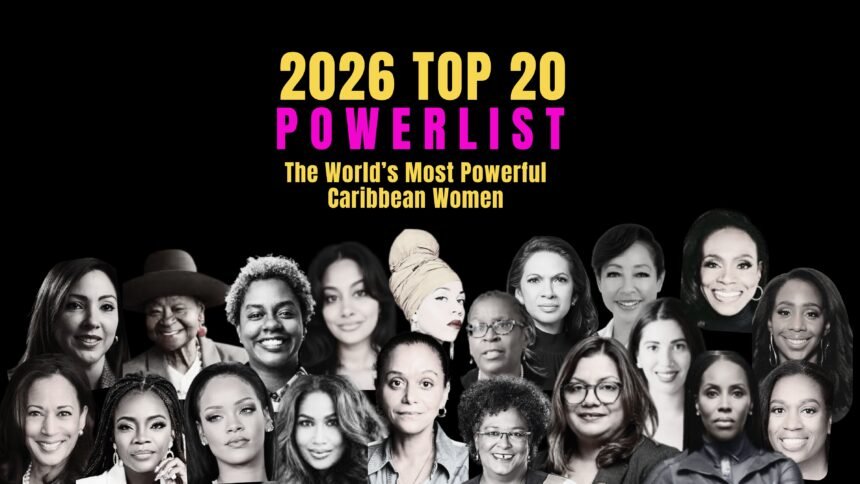
They built billion-dollar empires, brokered climate deals at the UN, mapped Cleopatra’s tomb, and broke a 35-year Emmy drought — and every single one of them traces her roots to a small island in the sea.
The world doesn’t always attach a flag to their names. But make no mistake: Caribbean women are running things — in boardrooms, parliaments, operating rooms, recording studios and archaeological dig sites from Alexandria to Washington, D.C.
This is the Caribbean Collective Power List 2026 — 20 women who didn’t just arrive at the table. They built it.
1. Nirmala Ramai — CEO, Caribbean Airlines, Indo-Trinidadian Heritage
She spent years learning how the plane runs. Then she took the controls.
Nirmala Ramai became CEO of Caribbean Airlines in October 2025, making history as the first woman to lead the region’s flagship carrier in its entire history. It was not a lateral appointment — she came through the company as chief operating officer, understanding the infrastructure of regional aviation before inheriting its leadership. Caribbean Airlines is more than a travel brand. It is the connective tissue of the Caribbean: the route between families, between economies, between islands that don’t always have another way to reach each other. Ramai now steers that responsibility in an industry still recovering from post-pandemic turbulence and facing intensifying competition from international carriers encroaching on regional routes.
When the region needs to move, she decides how.
Industry: Aviation and Corporate Leadership | Impact: Regional connectivity, economic development, women in executive leadership
View this post on Instagram
2. Dr. Carika Weldon — Founder and CEO, CariGenetics, Bermuda
The global map of human genomics had a blank space where the Caribbean should have been. She decided to fill it herself.
Dr. Carika Weldon is a genomics scientist who recognized that Caribbean populations were nearly absent from the global genomic research that increasingly drives precision medicine. Her response was not to petition existing institutions — it was to build her own. She founded CariGenetics, the first Caribbean-based genomics company, and launched the Caribbean Genome Programme, the first large-scale genomic sequencing initiative conducted entirely within the region. The implications are clinical and consequential: without Caribbean-specific genetic data, doctors treating Caribbean patients for conditions like breast and prostate cancer are working from research models that were never designed with those patients in mind. Weldon is changing that — one sequence at a time, in partnership with Oxford Nanopore Technologies.
Caribbean people deserve medicine that was built for Caribbean bodies. She is making sure it exists.
Industry: Science and Biotechnology | Impact: Health equity, regional research leadership, scientific innovation

Additional Read: [BLACK HERstory: 5 Caribbean Women Innovators Making History Today]
3. Lisa Hanna — Political Trailblazer, Chinese Jamaican Heritage
She had the world’s attention at nineteen. She decided to use it.
Lisa Hanna was crowned Miss World in 1993 — the third Jamaican woman to win the title — but her legacy was never going to be built on a crown. She transitioned into politics and in 2007 became one of the youngest women ever elected to Jamaica’s House of Representatives, representing Saint Ann South East. From 2012 to 2016, she served as Minister of Youth and Culture, where she championed education reform, cultural preservation and youth development programs that extended well beyond campaign season. What makes Hanna’s arc distinct is the continuity: she has spent nearly two decades in public service, showing up for constituents in a constituency, not just a cause. That is a different kind of discipline than a headline.
Global visibility is a platform. She chose to build a parliament with it.
Industry: Politics and Public Leadership | Impact: Youth advocacy, female political representation, national development
View this post on Instagram
4. Racquel Moses — CEO, Caribbean Climate-Smart Accelerator, Trinidad & Tobago
The Caribbean did not cause the climate crisis. Racquel Moses is making sure the world can no longer ignore who is paying for it.
As CEO of the Caribbean Climate-Smart Accelerator, Racquel Moses operates at the intersection of data, diplomacy and urgency. She leads climate partnerships across 29 countries, working alongside governments, private sector partners and international institutions to build the infrastructure of resilience before the next hurricane season demands it. Under her leadership, CCSA launched the Climate Smart Map — a data-driven platform helping policymakers and investors assess climate risks and identify opportunities across the region. Moses also serves as a global ambassador for the United Nations Framework Convention on Climate Change, ensuring that Small Island Developing States — nations that bear disproportionate climate consequences despite minimal emissions — have a voice at the table where global policy is shaped.
Small islands. Existential stakes. She is not asking for a seat at the table — she is running the meeting.
Industry: Climate Policy and Sustainability | Impact: Climate resilience, global climate diplomacy, regional sustainability

5. Sheryl Lee Ralph — Emmy Award–Winning Actress and Health Advocate, Jamaican Heritage
She waited 35 years for an industry to catch up. Then she gave one of the most unforgettable acceptance speeches television has ever seen.
Sheryl Lee Ralph won the Primetime Emmy Award for Outstanding Supporting Actress in a Comedy Series for her role in Abbott Elementary — becoming the first Black woman in 35 years to receive the honor in that category. But Ralph had been doing the work long before the industry decided to recognize it. In 1990, she founded The DIVA Foundation to advance HIV/AIDS awareness and prevention through arts and community engagement, at a time when the disease carried a stigma that most public figures actively avoided. The organization’s annual DIVAS Simply Singing! concert is now one of the longest-running HIV/AIDS benefit events in the United States — a record built not on celebrity capital but on sustained commitment over more than three decades.
She built the foundation before the fame arrived. That is the difference between a moment and a movement.
Industry: Entertainment and Philanthropy | Impact: Media representation, health advocacy, cultural leadership
View this post on Instagram
6. Gina Miller — Activist, Entrepreneur and Constitutional Campaigner, Indo Guyanese Heritage
She took the British government to the Supreme Court. Twice. And won both times.
Gina Miller was born in British Guiana to a father who prosecuted coup plotters across the Caribbean and defended political activists against an authoritarian government at home. That inheritance — that authority is not the truth; truth is the authority — became the organizing principle of her life in Britain. In 2016 she brought a landmark legal challenge establishing that Parliament, not the Prime Minister, had the constitutional authority to trigger Article 50 and begin the Brexit process. In 2019 she returned to the Supreme Court and won again, this time over the unlawful prorogation of Parliament. These were not symbolic gestures — they were constitutional interventions that changed the course of British political and legal history. Beyond her legal campaigns, Miller founded SCM Direct, a transparent investment platform, and has spent decades advocating for financial reform and consumer protection through the True and Fair Campaign.
She grew up watching her father stand up to power in Guyana. She simply continued the family tradition — in a different court.
Industry: Constitutional Law, Activism and Entrepreneurship | Impact: Democratic accountability, financial transparency, Caribbean diaspora representation in UK public life
View this post on Instagram
7. Rihanna — Entrepreneur, Music Icon and Philanthropist, Barbados
She looked at the beauty industry and saw a problem — then built a billion-dollar business by solving it.
Rihanna’s transition from music icon to global entrepreneur is one of the most studied business pivots of the past decade. Through Fenty Beauty, Savage X Fenty and Fenty Skin, she built a brand portfolio worth billions by doing what established beauty conglomerates had failed to do for generations: design for everyone. The 40-shade foundation launch alone reshaped industry norms overnight, forcing competitors to broaden their ranges in response. Beyond business, Rihanna maintains deep investment in the Caribbean and global diaspora through the Clara Lionel Foundation, which she founded in 2012. The organization funds global education initiatives, disaster relief and climate resilience programs — with targeted investment in communities across the Caribbean, East Africa and the U.S. South.
She didn’t disrupt the beauty industry. She replaced its assumptions.
Industry: Music, Beauty and Entrepreneurship | Impact: Inclusive beauty standards, global entrepreneurship, philanthropy
View this post on Instagram
8. Dr. Kathleen Martínez — Archaeologist and National Geographic Explorer, Dominican Republic
For two decades she has been searching for history’s most famous tomb. The evidence keeps pointing to the same place.
Dominican archaeologist Dr. Kathleen Martínez has led the Egyptian-Dominican archaeological mission at the Temple of Taposiris Magna near Alexandria since 2005 — one of the longest sustained searches for Cleopatra VII’s tomb in modern history. Her team has uncovered coins bearing Cleopatra’s image, elite burials and a massive underground tunnel that may lead to a royal chamber. A recent discovery of a submerged ancient port connected to the temple has strengthened theories about the final resting place of Cleopatra and Mark Antony. Martínez has pursued this work through funding challenges, political change in Egypt and decades of skepticism from archaeological institutions that were slow to invest in a Dominican scholar pursuing a question that had eluded Western academia for generations.
The world’s most famous woman may be found by a Caribbean one. History does not lack a sense of irony.
Industry: Archaeology and Historical Research | Impact: Global scholarship, cultural discovery, Caribbean representation in Egyptology
View this post on Instagram
9. Dr. Claire Nelson — Founder, Institute of Caribbean Studies, Jamaican Heritage
She moved to Washington, D.C. and decided the Caribbean deserved a seat in the room where American policy is made.
Dr. Claire Nelson is a Jamaica-born futurist, engineer and policy strategist whose work has carved out institutional space for Caribbean diaspora voices in Washington, D.C. She founded the Institute of Caribbean Studies, a nonprofit focused on research, advocacy and policy dialogue on issues affecting Caribbean communities across the Americas. Her most visible achievement may be the establishment of National Caribbean American Heritage Month in the United States — a recognition that transformed the visibility of Caribbean contributions in American civic life and created an annual platform that organizations, schools and institutions now build programming around. Nelson operates where engineering, futures thinking and political advocacy intersect, a combination that gives her influence in spaces most cultural advocates never reach.
Representation at the policy level doesn’t happen by accident. Someone has to build the institution first.
Industry: Policy and Engineering | Impact: Caribbean diaspora representation, policy influence, leadership development
10. Sherrese Clarke Soares — Founder and CEO, HarbourView Equity Partners, Jamaican Heritage
She figured out that songs are actually real estate — and built a firm around buying them.
Sherrese Clarke Soares entered private equity finance and looked at music catalogs the way sophisticated investors look at commercial property: as cash-flowing, appreciating assets with decades of runway. As founder and CEO of HarbourView Equity Partners, she has assembled a portfolio of more than $2.7 billion in assets under management, acquiring thousands of songs across major music catalogs. Before HarbourView, Clarke Soares spent years at Morgan Stanley and Warner Music Group, learning precisely where the money in culture lives before going to claim it. Recognized on the Forbes BLK 50 list, she now operates at a critical intersection — artists are fighting to own their masters, music rights are consolidating rapidly, and HarbourView sits at the center of that transformation with a Jamaica-heritage woman holding the controls.
Culture has always generated wealth. She is the architect who decided Caribbean women would manage it.
Industry: Private Equity and Entertainment Finance | Impact: Cultural asset investment, financial innovation, industry transformation
View this post on Instagram
11. Shivani Jorawar — Co-Founder, Jahajee Sisters, Indo Guyanese Heritage
She identified a community whose voices had been left out of the gender justice movement — and built the organization to bring them in.
Shivani Jorawar is a gender justice advocate and co-founder of Jahajee Sisters, an organization advancing immigrant rights, LGBTQ+ inclusion and gender justice within Indo Caribbean communities. The Indo Caribbean diaspora occupies a particular position in American political life — present in significant numbers, culturally distinct, and historically underrepresented within both mainstream immigrant advocacy and broader Caribbean diaspora organizing. Jorawar has worked to change that through policy advocacy, community education and sustained national media engagement that elevates Indo Caribbean perspectives within reproductive justice and immigrant rights conversations. The word jahajee — meaning shipmate, referencing those who crossed the kala pani together — carries within it a philosophy of collective survival. Jorawar has built an organization worthy of the name.
Justice that excludes anyone was never really justice. She is making sure the movement knows that.
Industry: Social Justice and Policy Advocacy | Impact: Gender equity, immigrant rights, diaspora leadership
View this post on Instagram
12. Mia Mottley — Prime Minister, Barbados
She leads one of the smallest nations on earth and has become one of the most consequential voices in global climate politics.
Mia Mottley made history as Barbados’ first female prime minister and then immediately expanded the scope of what that title could mean on the world stage. She led Barbados’ transition to a republic in 2021, severing constitutional ties to the British monarchy after nearly four centuries. Internationally, Mottley has become the defining voice for small island states in global climate negotiations — her Bridgetown Initiative, which calls for a fundamental restructuring of international finance to better equip vulnerable nations for climate adaptation, has reshaped the terms of the debate at COP summits and beyond. She operates with moral authority that larger nations, despite their resources, have struggled to match.
She represents 280,000 people and negotiates for billions. That is not a contradiction — that is leadership.
Industry: Government and Global Policy | Impact: Climate diplomacy, economic reform, small island states advocacy
View this post on Instagram
13. Samira Nasr — Editor-in-Chief, Harper’s Bazaar, Trinidadian Heritage
She walked into a 150-year-old institution and became the first person who looked like her to run it.
When Samira Nasr was appointed editor-in-chief of Harper’s Bazaar in 2020, she became the first person of color to hold the role in the magazine’s entire history. That is not a footnote — it is the headline. What she has done with the platform since is equally significant: expanding the visual language of fashion to include the textures, references and faces that a more homogeneous editorial culture had long kept to the margins. Nasr brings Trinidadian heritage and a career forged across Vogue, Elle and Vanity Fair to a role that shapes how millions of people understand beauty, style and culture. She is not simply diversifying an existing vision. She is building a new one.
Fashion has always been about who gets to define beauty. She has expanded the answer.
Industry: Fashion Media | Impact: Cultural representation, editorial leadership, global fashion influence
View this post on Instagram
14. Kamala Harris — Former Vice President of the United States, Jamaican Heritage
She broke barriers that had stood for more than two centuries. No one can take that back.
Kamala Harris made history as the first woman, first Caribbean American and first South Asian American to serve as Vice President of the United States — a milestone whose weight will only grow with time. Her father, Donald Harris, is Jamaican, and the Caribbean diaspora claimed her election as its own. In 2024, Harris became the Democratic presidential nominee after a compressed campaign launch, raising more than $1 billion in under four months — one of the fastest fundraising operations in American political history. She did not win the presidency, but the question of what her candidacy represented — and what it made possible for those watching — is not diminished by the outcome. Political firsts are permanent even when campaigns are not.
History does not have a reset button. What she did is written.
Industry: Politics and Public Leadership | Impact: Global political influence, representation, democratic leadership
View this post on Instagram
Additional Read: [Trailblazer Racquel Moses on Climate Change, Gender Equality and the Future of the Caribbean]
15. Calypso Rose — Calypso Music Legend, Trinidad and Tobago
She entered a musical tradition that had never let a woman win — and then she won it.
Calypso Rose has been writing, performing and fighting for recognition in calypso music for more than six decades. In 1978, she became the first woman to win the Calypso Monarch title — a crown the industry had implicitly reserved for men. She has since written more than 800 songs, addressing gender equality, social justice and Caribbean identity with the same wit and precision that define the art form at its best. Her longevity is not passive — she has continued performing and recording into her eighties, becoming the oldest artist ever to perform a full set at Coachella. Calypso Rose did not just break a gender barrier in Caribbean music. She became the standard against which the tradition is now measured.
She did not ask for access. She made herself impossible to ignore.
Industry: Music and Cultural Heritage | Impact: Cultural preservation, gender equality in music, global Caribbean artistry
View this post on Instagram
16. Nirmala Ramprasad — Founder, Green Dupatta, Indo Guyanese Heritage
She built a sustainability organization that starts where change actually begins — in the community, with the people who live there.
Nirmala Ramprasad founded Green Dupatta with a model that rejects the top-down approach that has limited so much environmental advocacy: she starts at the ground level, with women and youth in Guyana, Canada and India, and builds from there. The organization promotes environmental education, urban gardening, sustainable agriculture and youth leadership programs designed not just to raise awareness but to install the practical skills that make environmental responsibility livable and lasting. The dupatta — a garment carried close — is a deliberate metaphor: this is sustainability worn as identity, not announced as ideology. In a region facing intensifying climate vulnerability, Ramprasad’s grassroots model offers something that global frameworks often cannot — staying power.
The green movement needs more builders working from the ground up. She is one of them.
Industry: Environmental Sustainability | Impact: Climate awareness, community development, grassroots environmental leadership
View this post on Instagram
17. Fiona Compton — Founder, Know Your Caribbean, Saint Lucia
She asked a simple question — do Caribbean people actually know our own history? — and built a movement around the answer.
Fiona Compton did not wait for a publisher, a grant or an academic institution to validate the idea that Caribbean history deserved to be told by Caribbean people. The Saint Lucian historian and cultural advocate launched Know Your Caribbean as a digital-first platform that meets diaspora audiences where they are — on their phones, between commutes, scrolling late at night wondering why no one taught them this in school. Hundreds of thousands of followers later, the platform has become a reference point for a generation actively reclaiming identities that colonial education systems spent centuries editing out. Compton also co-founded Caribbean Green Book, an initiative connecting community members to Caribbean-owned businesses and cultural spaces — turning cultural pride into economic action.
Preservation is not passive. In Compton’s hands, it is political.
Industry: Education and Digital Media | Impact: Cultural education, diaspora identity, historical preservation
View this post on Instagram
18. June Ambrose — Fashion Stylist and Creative Director, Jamaican Heritage
She dressed the architects of hip-hop and in doing so, dressed a generation.
June Ambrose is widely credited with translating hip-hop’s cultural energy into a visual language that high fashion eventually had to acknowledge. Working with Missy Elliott, Jay-Z, Mary J. Blige and Alicia Keys at the height of their cultural dominance, she built looks that defined album eras and shaped the way an entire generation understood style. Her Jamaican heritage informed an aesthetic that moved between worlds — streetwear and couture, braggadocious and architectural — with an authority that came from genuine creative vision. Today, Ambrose continues to influence fashion through creative direction and brand partnerships while actively mentoring emerging designers, ensuring that the next generation of stylists has access to the institutional knowledge she spent decades building.
She gave hip-hop its look. The fashion industry is still catching up.
Industry: Fashion and Creative Direction | Impact: Cultural influence, mentorship, global fashion innovation
View this post on Instagram
19. Whenda “Wanda” Tima-Gilles — Founder, L’Union Suite, Haitian Heritage
When the world’s dominant narrative about Haiti was one of crisis, she built a platform to tell a different story.
Whenda “Wanda” Tima-Gilles founded L’Union Suite in 2011 with a straightforward conviction: Haiti’s story was larger, richer and more complex than the disaster coverage that defined it in international media. More than a decade later, the digital platform has grown into one of the most influential voices in Haitian diaspora storytelling, reaching millions globally through cultural programming, community initiatives and narrative journalism that centers Haitian excellence. The work is not optimistic propaganda — it is honest, grounded storytelling that refuses to reduce a nation of 11 million people to its worst moments. In an information environment where narratives calcify quickly, Tima-Gilles has built an institution that consistently offers an alternative.
The story of Haiti is still being written. She is one of the people holding the pen.
Industry: Digital Media and Cultural Storytelling | Impact: Diaspora engagement, cultural representation, media influence
View this post on Instagram
20. Abby Phillip — CNN Anchor and Political Journalist, Trinidadian Heritage
In one of the most fractured media moments in American history, she became one of its most trusted voices.
Abby Phillip anchors CNN’s prime-time program News Night with Abby Phillip, leading political coverage at a network navigating significant audience shifts and an increasingly complex news cycle. Her Trinidadian heritage is part of a background that has shaped both her perspective and her professional discipline — she approaches political analysis with a rigor that cuts through the temperature of the moment. As an author, her book A Dream Deferred examines the political impact of Jesse Jackson’s presidential campaigns and the long arc of Black political power in America, demonstrating that her journalism extends beyond the broadcast to the historical record. In a media landscape increasingly defined by noise, Phillip has built a reputation on precision.
The best political journalism doesn’t just cover history. It helps people understand it while it’s happening.
Industry: Journalism and Media | Impact: Public discourse, political analysis, media leadership
View this post on Instagram
The Future of Caribbean Leadership
The influence of Caribbean women continues to grow across industries and continents. From global diplomacy to cultural leadership and entrepreneurship, their contributions are shaping the future of international dialogue and innovation.
The women featured on the Caribbean Collective Power List 2026 represent more than individual achievement. They reflect a broader movement of Caribbean excellence — one defined by resilience, leadership and a commitment to shaping the future.
Who Should Be on the 2027 Power List?
The Caribbean Collective Power List is an annual recognition of influential Caribbean women across the globe.
Know a Caribbean woman making an impact in business, politics, culture or community leadership?
Submit your nomination for the 2027 Caribbean Collective Power List.