

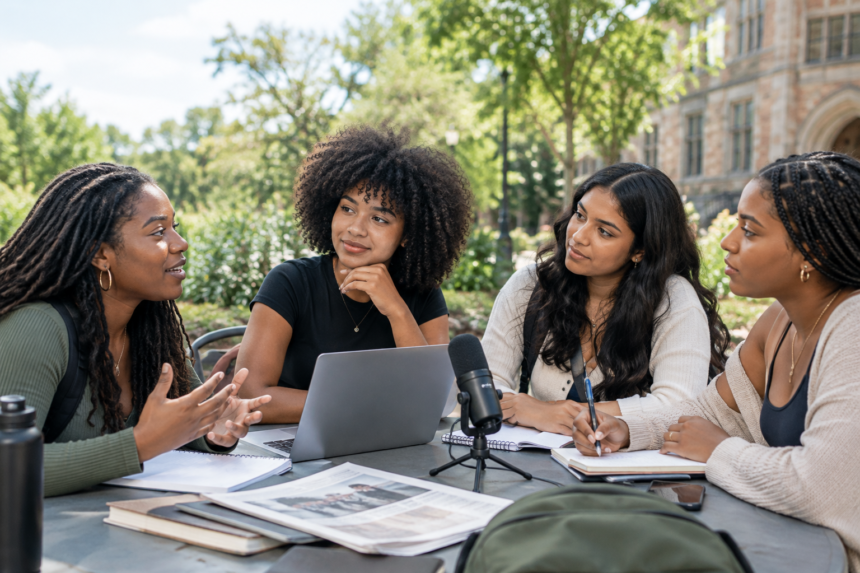
Caribbean girls and young women do not have to wait for someone else to tell their stories. A student newsroom, a podcast mic or a phone can be a starting point. What matters is what comes next: asking thoughtful questions, checking facts and staying connected to the people whose stories you share.
Why Student Journalism Matters
You’ve heard about it. You’ve seen it across social media. The case widely known as “Jane Doe vs. the Cornell 7” has brought national attention to allegations of sexual violence and questions about Cornell University’s response. But before the national headlines, student journalists on Cornell’s campus were doing the reporting.
Meet Cereese Qusba, The Cornell Daily Sun’s senior editor and lead reporter on the story, and Sophia Dasser, its editor-in-chief. Associate editor Sophia Romanov Imber and opinion editors Zara Cheek and Rayen Zhou also helped shape the newspaper’s editorial response. Qusba pursued the story for nearly two years before publishing her September report on the lawsuit.
View this post on Instagram
Her article, “Cornell, Chi Phi Sued by Victim of Alleged Gang Rape, Drugging in 2024,” brought the allegations and the university’s response into public view. The paper kept covering the case afterward, while its editors pressed for transparency and accountability. The allegations remain contested, and the accused men have denied wrongdoing. Journalism does not determine guilt, but it can scrutinize institutional decisions and keep unanswered questions from disappearing.
As Cheek told Her Campus:
So many of these national headlines would not be possible without the local headlines that were written first.
That idea carries over to us. Long before an issue becomes a trending topic, someone close to the community has to notice it, ask questions and write it down.
Caribbean girls know the frustration of having someone else define our community. Some of us grew up hearing our islands described by people who did not live in them. Others grew up in diaspora communities in Brooklyn, Toronto, London or Miami, where our families’ stories could be squeezed into a single line. Student media gives us an opportunity to write a fuller first draft of how our communities are seen.
[Additional Read: Caribbean Girl Magic: Inside Dalise Lockhart’s Journey of Faith, Flight and Caribbean Excellence ]
Your Newsroom Is Everywhere
You do not need to start with a national publication. Start with a story you care about and a platform you can use.
- Student newspapers. Pitch a column, profile or reported piece. Cover your Caribbean student association’s carnival, the cost of tuition for international students or the barriers students face when seeking support after harassment. Celebration and scrutiny can belong in the same publication.
- Podcasts. Use conversation to make room for experiences that need more than a caption. For inspiration, Island Girls Rock, hosted by Chantal Miller, brings Caribbean girls and women together to share stories, creativity and lived experience across generations and the diaspora.
- Oral histories. Interview relatives, neighbors and community elders with their permission. Your grandmother’s porch stories can be the beginning of an oral-history project. When a memory becomes part of a reported piece, distinguish personal recollection from facts you can independently verify.
- Social media. Use short videos, carousels and captions to share reporting, explain an issue or publish a personal essay. Make the distinction clear: a firsthand experience, an opinion and a verified finding are not interchangeable.
- Anthologies and creative writing. Poetry, fiction and spoken word can also contribute to the public record. In August 2026, Saint Lucia’s CARICOM Youth Ambassadors launched What CARICOM Means to YOUth, gathering creative contributions from young people ages 10 to 28 across nine CARICOM member states.

Real Voices, Real Possibilities
The Saint Lucia anthology recognized Daviah Frank of St. Vincent and the Grenadines for Best Poetic Contribution and 14-year-old Ezekiel Francis of Trinidad and Tobago for Best Narrative/Expository Contribution. Organizers described the collection as an “archive of how a generation of Caribbean young people understood their community at this particular moment in our history.
You do not have to wait until adulthood to contribute to that record.
Youth advocacy offers another route. The Healthy Caribbean Coalition’s Caribbean Youth Voices initiative has supported young people’s participation in health decision-making and helped develop a handbook for meaningful youth engagement. Its Art for Action competition invited young people to use storytelling and creative expression under the theme “Nothing For Us Without Us.” The principle is straightforward: young people should help shape decisions affecting their health and well-being, not simply be invited to observe them.
There are models in print, too. Alissa Trotz’s “In the Diaspora” column in Guyana’s Stabroek News welcomed contributions from high school, undergraduate and graduate students alongside artists, journalists and activists. Some contributors had never published before, and pieces were republished in newspapers elsewhere in the Caribbean and in Toronto.
These examples show different ways to participate: reporting, creative writing, public commentary and advocacy. They are not the same practice, but each can make space for voices that deserve to be heard.
Use Your Voice for Safety and Equality
Visibility matters. But the larger goal is accountability.
A campus publication can ask whether harassment-reporting procedures are clear. A podcast can explore what students need from support services. A reported carousel can compare an institution’s published commitments with the resources students can actually access.
The Cornell journalists also offer a lesson in care. Dasser described limiting communication with Jane Doe primarily to the lead reporter to help protect her anonymity. Bringing a story into public view did not require revealing the identity of the person at its center.
Carry that care into your own work. Do not pressure someone to disclose a painful experience. Discuss how their words will be used, avoid promising confidentiality you cannot protect and seek experienced editorial guidance before publishing sensitive allegations.
Our advocacy should not ask people to sacrifice their privacy to prove that their safety matters.
Challenge the Narrative
Before you pitch, ask yourself:
- Who is missing? Are Afro-Caribbean, Indo-Caribbean, Garifuna, Haitian or Spanish-speaking Caribbean girls included and able to speak for themselves?
- What does the postcard version leave out? Look beyond beaches and rum to housing, mental health, colorism, climate change, accessibility and safety.
- What needs evidence? Identify the documents, interviews and independent sources that could support or challenge your premise.
- Who should respond? Give people and institutions a fair opportunity to answer material claims about them.
- Are you protecting the people in the story? Consider consent, identifying details and the potential consequences of publication.
The strongest story is not always the loudest. It is the one that helps readers understand something clearly and treats its sources responsibly.
Start Now
Choose one manageable step:
- Email your campus paper’s editor a three-sentence pitch: the story, why it matters and how you would report it.
- Record a 10-minute voice memo exploring a story from home. Use it to develop a podcast outline.
- Create a sourced carousel explaining one misconception about your island.
- Join or start a Caribbean student zine or newsletter with clear expectations for fact-checking and credit.
- Read your campus’s published safety policies and identify one question worth investigating.
Virality fades. Commitment to a community should not. As Imber told Her Campus, “The national attention will eventually move elsewhere, but our responsibility to the Cornell community does not.
Caribbean Girl Magic can mean writing, recording and publishing with that same care. Our voices belong in stories that celebrate us and in the questions that challenge institutions to protect us and treat us equally.
Caribbean girls and young women do not have to wait for someone else to tell their stories. A student newsroom, a podcast mic or a phone can be a starting point. What matters is what comes next: asking thoughtful questions, checking facts and staying connected to the people whose stories you share.