
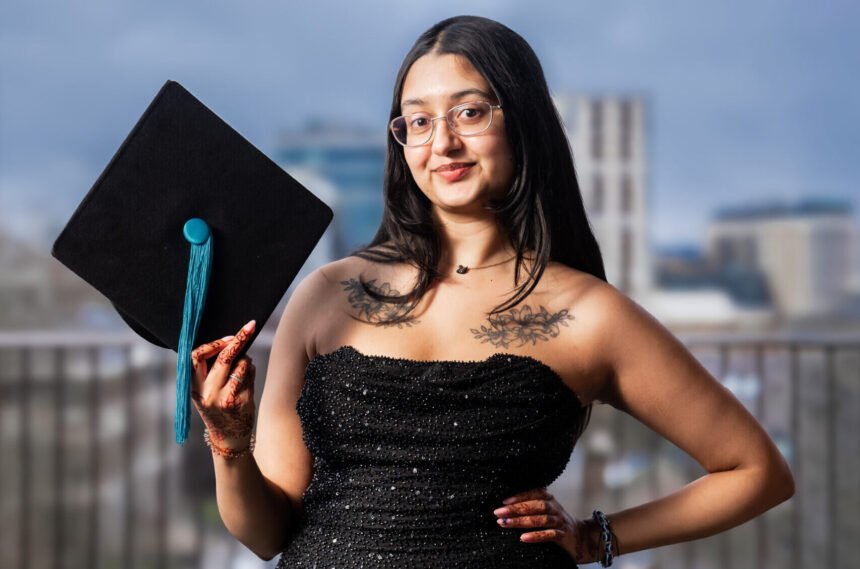
There is something deep about choosing to put your culture on someone else’s skin. For Jenna, a scientist, artist and the woman behind Henna With Jenna — every design she draws is a small act of cultural reclamation. It’s an Indo-Caribbean story pressed gently into henna paste, left to stain, left to last.
- Growing up as an Indo-Caribbean, I connected with my culture in many ways, especially through food and music, she reflects. I have a particular love for 90s soca and pine tarts.
- I wanted to reconnect with my South Asian identity, and henna felt like the perfect way to do that.
- [Additional Read: Guyanese American Karen Young of Oui the People on Redefining Beauty with Purpose ]
- I believe henna should feel personal and meaningful, she says. Each design should reflect the client’s story and make their henna truly unique to them.
- Traditionally, the deeper the color of the henna stain, the more it’s said to represent love and positivity for the marriage, she explains. Beyond the symbolism, the application also acts as a social moment filled with music, dancing, and laughter.
- I love connecting with the bride and understanding her design requirements — creating designs that portray her love story. Whether it’s the place where they first met, a combination of both cultures, pets, or even football teams.
- That conversation really stayed with me, she says. It reminded me that henna can tell a story about the bride, her heritage, and her journey.
- I have enjoyed connecting with different artists and learning of their different cultures and traditions,” she says. And equally, I take pride in sharing my own.
- It can get quite hectic, she admits. But it is also really rewarding.

Born in Georgetown, Guyana, and raised in the U.K., Jenna grew up navigating the particular tension familiar to many children of the diaspora. She found herself deeply connected to one side of her heritage, while being quietly curious about another.
Growing up as an Indo-Caribbean, I connected with my culture in many ways, especially through food and music, she reflects. I have a particular love for 90s soca and pine tarts.
The warmth of those memories is unmistakable in Jenna’s descriptions. And yet, for a long time, the South Asian half of her story felt further away.
I wanted to reconnect with my South Asian identity, and henna felt like the perfect way to do that.
What changed that was, by her own account, an almost accidental moment. A university friend picked up a henna cone. A few designs later, something shifted. “It ignited the fascination with henna that I had forgotten during my childhood,” she says. “Almost immediately, I decided to make my own henna and create my own designs.” The scientist in her began to practice with methodical precision. The artist in her began to flourish.
[Additional Read: Guyanese American Karen Young of Oui the People on Redefining Beauty with Purpose ]
The First Stain
Jenna’s earliest memory of henna is a vivid one: she was five years old, running across a school fair to be first in line. She drew over the drying paste, trying to make the color last longer. “I was captivated by how beautiful the florals and lines were,” she says. That enchantment never truly left — it simply waited. Years of two STEM degrees, research and academic rigor, ran in parallel to a quiet creative life of painting and drawing. Yet creativity, she says, “naturally followed me.”
The tipping point came when people began asking about the henna designs she wore on herself: Who did your henna? “It made me realize that it could, potentially, be a viable business,” she says. “And I am extremely glad I took the initiative to make that step, even though it was scary.”Since then, Henna With Jenna has grown into a practice of 300 plus traditional and tattoo-style designs, served to clients across London and beyond.

Identity in Every Motif
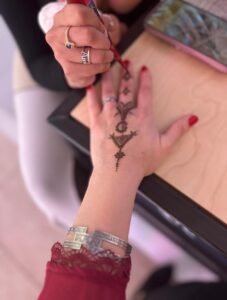
For Jenna, henna has never simply been a decoration. It is language. Her Indo Caribbean identity threads through every design she creates, from the bold floral patterns drawn from Indian henna traditions to the lotus and water lily motifs she returns to again and again. “The lotus and water lily are particularly meaningful to me,” she explains, “as the national flower of Guyana.” It is a small, powerful act of geography: placing the Caribbean into an ancient South Asian art form, making visible a heritage that rarely sees itself reflected.
View this post on Instagram
This instinct toward representation is deeply personal. “Growing up as an Indo Caribbean girl, there was very little representation within the media,” she says. “Outside of family, I didn’t get much exposure to other Indo-Caribbean individuals.” Rather than turning away from that absence, Jenna turned it into a principle. She is intentional about incorporating her clients’ own identities into their designs — national flowers, cultural motifs, fragments of personal story.
I believe henna should feel personal and meaningful, she says. Each design should reflect the client’s story and make their henna truly unique to them.
Mehndi and Memory
Nowhere is that philosophy more resonant than in her bridal work. Henna carries enormous significance within Indo-Caribbean wedding traditions — a lineage preserved and adapted across generations from its South Asian origins. The mehndi ceremony is a pre-wedding ritual of joy, symbolism, and community — a gathering of aunties, cousins, and friends around the bride as her hands and arms are adorned.
Traditionally, the deeper the color of the henna stain, the more it’s said to represent love and positivity for the marriage, she explains. Beyond the symbolism, the application also acts as a social moment filled with music, dancing, and laughter.
She speaks about bridal henna with particular reverence. Her favorite part of the entire process, she says, is learning the love story.
I love connecting with the bride and understanding her design requirements — creating designs that portray her love story. Whether it’s the place where they first met, a combination of both cultures, pets, or even football teams.
Each detail becomes a design element. Each design becomes a memory. Though she has yet to work with an Indo Caribbean bride, the aspiration is very much alive. A single conversation brought its significance sharply into focus. After posting a Guyana-inspired henna design that went viral, a Guyanese woman reached out to tell her she wished she had incorporated something similar into her own bridal henna.
That conversation really stayed with me, she says. It reminded me that henna can tell a story about the bride, her heritage, and her journey.
Community and Visibility
London, where Jenna is based, pulses with some of Britain’s most vibrant cultural diversity. Yet the Indo Caribbean community, she notes, remains relatively dispersed; still finding and building itself in the U.K. context. “There is not much of an Indo Caribbean community here, at least as far as I am aware,” she says honestly. “But I do feel this is slowly changing.” Social media has allowed for a growing community. Instagram, in particular, has created spaces for Indo Caribbean people to share experiences, celebrate culture, and recover histories that mainstream representation had largely overlooked.

Jenna’s own platform is a growing community of around 3,000-plus followers. It reflects that hunger for visibility. She uses it to share both her henna work and her cultural perspective, connecting with artists and clients from across the world.
I have enjoyed connecting with different artists and learning of their different cultures and traditions,” she says. And equally, I take pride in sharing my own.
Jenna plans to celebrate Guyana’s Independence Day in May. “Currently, there are very few Guyana-inspired henna designs,” she notes. “I hope to change that.” She emphasizes that creativity and cultural expression are powerful ways in which we can connect our roots and share our stories with the world.
Science and Art
It would be easy to present Jenna’s story as a pivot — the scientist who became an artist. But that framing would miss something important. Hers is not a story of abandoning one identity for another. It is a story of integration. Alongside Henna With Jenna, the artist runs a separate art business along with her career in the sciences.
It can get quite hectic, she admits. But it is also really rewarding.
Jenna refuses to choose between the analytical and the creative, between Caribbean and South Asian descent, between who she was told she was and who she knows herself to be. That refusal to be boxed into one category has allowed her to grow. It is there in designs built to hold personal stories. It is there in her insistence that bridal henna should reflect not just beauty but biography. It is there in the lotus motif she returns to, a flower that commonly grows in Guyana.
Her advice to young creatives considering a leap is: “Just start. It does not have to be perfect from the beginning. Starting something, no matter how big or small, allows you to build a foundation for something much bigger.” She adds warmly: “The small-business community is incredibly supportive. I am a proud Guyanese. I feel so honored to have the opportunity to talk about my identity, my work, and connect with other Indo Caribbean individuals.”
To see designs visit Henna with Jenna here.