
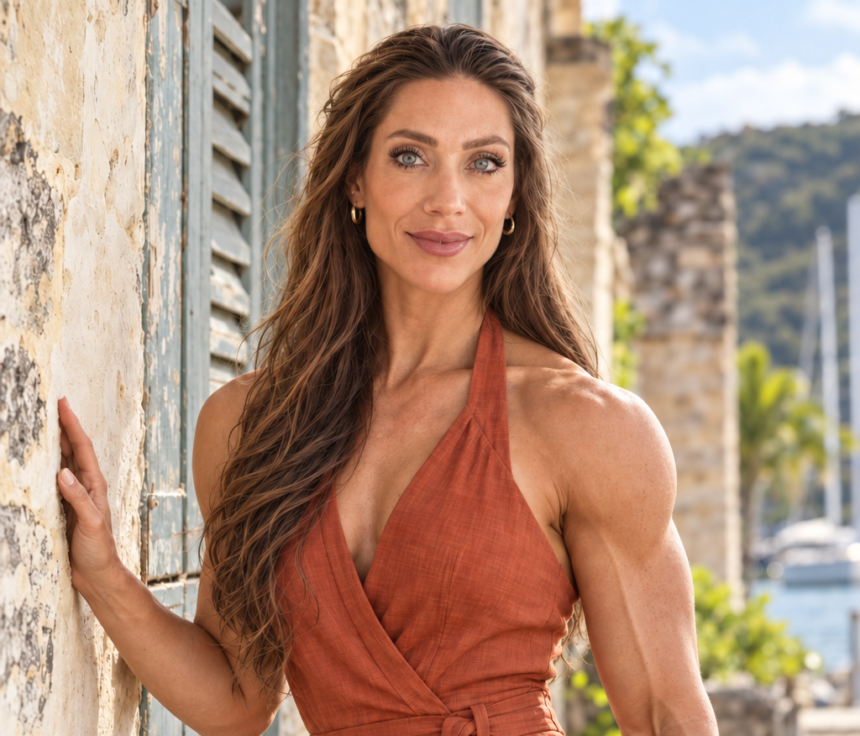
There is a particular kind of trust that gets built in a gym, the kind that forms when two people are sweating through the same set, pushing past the point where quitting would be easier. Dr. Nicole Rakowski has learned to use that trust as a doorway. On one side is a workout. On the other is a young man beginning to believe his life could look different.
- [Additional Read: The Hakka People of Jamaica: How One Woman is Refusing to Let Her People be Forgotten ]
- Before the accident, strength was something I associated primarily with performance, she said. Afterward, strength became about resilience. It became about rebuilding when circumstances take control away from you.
- That journey taught me that transformation is not about erasing what happened to you, she said. It is about deciding what you are going to build from it.
- Sometimes if you tell a young man that you want to speak to him about discipline, accountability or emotional health, he may immediately put up a wall, she said. But if you say, ‘Come train with me,’ the dynamic changes.
- The gym became a classroom without feeling like a classroom, she said. They chose to respect me. They were not obligated to do so. That was the difference.
Rakowski’s own story reads like a study in reinvention. She holds a doctorate in health management and has built her career at the crossroads of longevity science, human performance and education. In 2026, she earned her International Federation of Bodybuilding and Fitness professional status in Barbados, a milestone that sits alongside two TEDx talks, contributions to Muscle & Fitness, a spot on NYC Journal’s Top 40 Under 40 list, and international media coverage including the BBC. On paper, it is the resume of someone who has spent a career chasing achievement. In conversation, it becomes clear that achievement was never really the point.
“What connects all of these things for me is transformation,” she said. Whether she is coaching an athlete toward an elite level, speaking to a packed room or sitting with a struggling teenager, the question underneath all of it stays the same: How do you help someone become a stronger, more capable version of themselves?
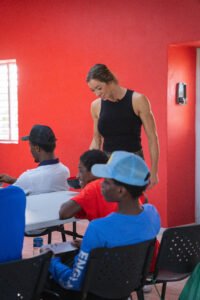
Photo courtesy of Hosea Wiltshire
To understand why Rakowski’s work now centers on young people in crisis, it helps to go back to 2017, when she was involved in a catastrophic accident in Iceland and fell into a boiling geothermal spring.
[Additional Read: The Hakka People of Jamaica: How One Woman is Refusing to Let Her People be Forgotten ]
The injuries were severe. The recovery was long and painful, both physically and psychologically. For someone who had built her identity around discipline, performance and control, waking up to a body that was burned and scarred forced a complete reckoning with what strength actually means.
Before the accident, strength was something I associated primarily with performance, she said. Afterward, strength became about resilience. It became about rebuilding when circumstances take control away from you.
That shift changed her relationship with medicine and health entirely. She often describes her goal as moving from the hospital bed to the foot of it, trading the role of vulnerable patient for the role of someone equipped to help others through their own hardest moments. Bodybuilding became part of that rebuilding, not as vanity but as a way to reclaim agency over a body that had been through trauma. The same body that had been injured and marked was the one she eventually brought to a professional stage.
That journey taught me that transformation is not about erasing what happened to you, she said. It is about deciding what you are going to build from it.
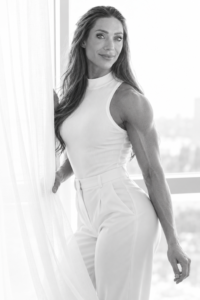
Photo courtesy of Christopher Sulowski
Rakowski’s connection to Antigua and Barbuda started with her husband’s work as an emergency pediatrician at Sir Lester Bird Medical Centre. What began as simply living on the island turned into something deeper the longer she stayed.
It was through those local connections that she learned about the Denis Bowers Rehabilitation Centre and the young men living there. Her instinct was immediate: Fitness could be the way in.
Sometimes if you tell a young man that you want to speak to him about discipline, accountability or emotional health, he may immediately put up a wall, she said. But if you say, ‘Come train with me,’ the dynamic changes.
That single idea became the foundation for a program that would go on to reach 16 young Caribbean men at the center, using barbells and burnout sets as the entry point into far bigger conversations.
Rakowski described her time with the group at Denis Bowers as one of the most meaningful experiences of her life in Antigua. The physical training was demanding by design. She wanted them to hit a wall so she could help them rebuild past it, and that intensity is what got their attention in a way nothing else had before.
But the real work happened afterward, in conversations about relationships, decisions, fears and futures. She also used an anonymous question box, giving the boys a way to ask what they might never say out loud in front of the group.
The message she kept returning to was simple: A difficult upbringing, a mistake or time spent in a rehabilitation center does not have to become a permanent identity.
She is candid about the gaps in support these young men face. “I have fought to have more support and funding for these boys, and it is proving extremely difficult,” she said. “It seems there are so many barriers where there really shouldn’t be. These poor boys are relapsing because they do not have continuity.”
She is careful not to frame this as strictly a Caribbean problem. Men everywhere struggle to ask for help or show vulnerability, she said. But smaller island communities face real constraints around specialist resources, funding and stigma that make continuity of care especially hard to sustain. Her broader point is that the first doorway into mental health support does not always have to be a therapist’s office. Sometimes it is a coach, a gym or a mentor who earns enough trust to eventually lead someone toward more structured care.
The bond she has built with the boys became visible in an unexpected way. For her birthday, the group made her something she was told they had never made for anyone else in their lives. “They look up to me as a mentor, a leader and an athlete,” she said. “Sports connects people in unimaginable ways.”
Rakowski is deliberate about why she never treated this as a lecture series. Young men who have already had adults tell them what to do tend to shut down fast when they feel spoken at rather than spoken with.
Instead, she asked questions: What do you want? What makes you angry? What are you afraid of? What kind of man do you want to become? What do you want your life to look like in five years?
The physical training became a live demonstration of the answers. A boy who wanted to quit but kept going was practicing perseverance in real time. A boy who encouraged a struggling teammate was practicing leadership. A boy who got frustrated and managed his reaction was practicing emotional regulation.
The gym became a classroom without feeling like a classroom, she said. They chose to respect me. They were not obligated to do so. That was the difference.
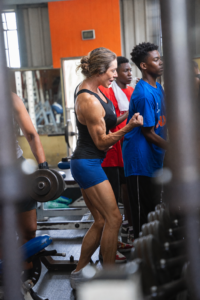
Photo courtesy of Hosea Wiltshire
For Rakowski, the clearest sign that something real had taken hold came at the end of the program, when the boys started asking when she was coming back. Seven asked specifically about continuing mentorship. Five asked to keep training.
Nobody prompted them to ask. They simply wanted more.
“It made me realize just how much hunger there can be beneath the surface for structure, attention, guidance, accountability and opportunity,” she said. Her takeaway is that society tends to notice a young person’s behavior first, when the more useful question is what sits underneath that behavior. In her experience, most young people are looking for someone who challenges them, holds them accountable and still believes they are capable of something better, rather than someone focused only on what they have already done wrong.
One moment in particular stayed with her. During a one-on-one conversation, one of the boys admitted his dream was to become a well-known artist. Rakowski arranged for a respected local artist to surprise the group with a lesson. The artist ended up donating one of his drawings to the boys, and the teenager who had shared his dream was moved to tears, telling her that no one had ever done anything like that for him before.
That moment is part of why Rakowski is now working toward something bigger than a single program. Her vision is a structured youth fitness, leadership and mentorship initiative that uses training as a foundation but expands into communication, emotional regulation, nutrition, decision-making, career planning and confidence-building.
Exposure matters just as much to her as curriculum. She wants to bring in business leaders, health care professionals, entrepreneurs and mentors from different fields so young people can see possibilities they might never have considered otherwise.
Consistency is the piece she keeps coming back to. A single motivational talk feels good for an hour. Real change requires adults who remember names, remember goals and keep showing up long after the first conversation ends.
She is equally direct about what needs to change at a community level. “Many politicians and leaders say they will get back to you and never do,” she said. Her argument is that accountability and compassion are not opposites. Young people need boundaries and consequences, but accountability has to lead somewhere. If a mistake made at 15 or 16 permanently defines a young man in the eyes of his community, that is not rehabilitation. It is a label.
She also believes strongly that young men need more women actively mentoring them, not only male role models. A strong female presence that models discipline, integrity and leadership adds something that male mentorship alone cannot replicate.
Most of all, she wants communities to follow through on the idea of a second chance by actually creating somewhere for young people to go once they have earned it. “You cannot tell someone they deserve a second chance and then give them nowhere to go with it,” she said. “That is what is currently happening here, and we are fighting to make that change possible.”
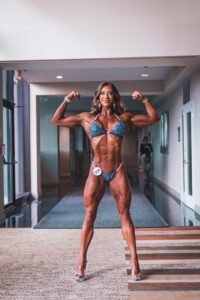
Photo courtesy of Ray Fit Photography
Looking ahead, Rakowski wants her relationship with Antigua and Barbuda to keep deepening, particularly around health, fitness, longevity, mentorship and youth development. But she is careful about how she defines success in this next chapter.
“Legacy is not really about being remembered,” she said. “It is about creating a ripple effect.” If a young man she mentors eventually mentors someone else, that is legacy. If discipline learned through fitness carries over into school, work or rebuilding a life, that is legacy.
After a career spent pursuing excellence academically, professionally and athletically, Rakowski is now focused on a different question: What that excellence can be used for. She said she would be proud if a meaningful part of the answer was built here, in Antigua and Barbuda, one training session and one honest conversation at a time.