
written by Tiara Jade
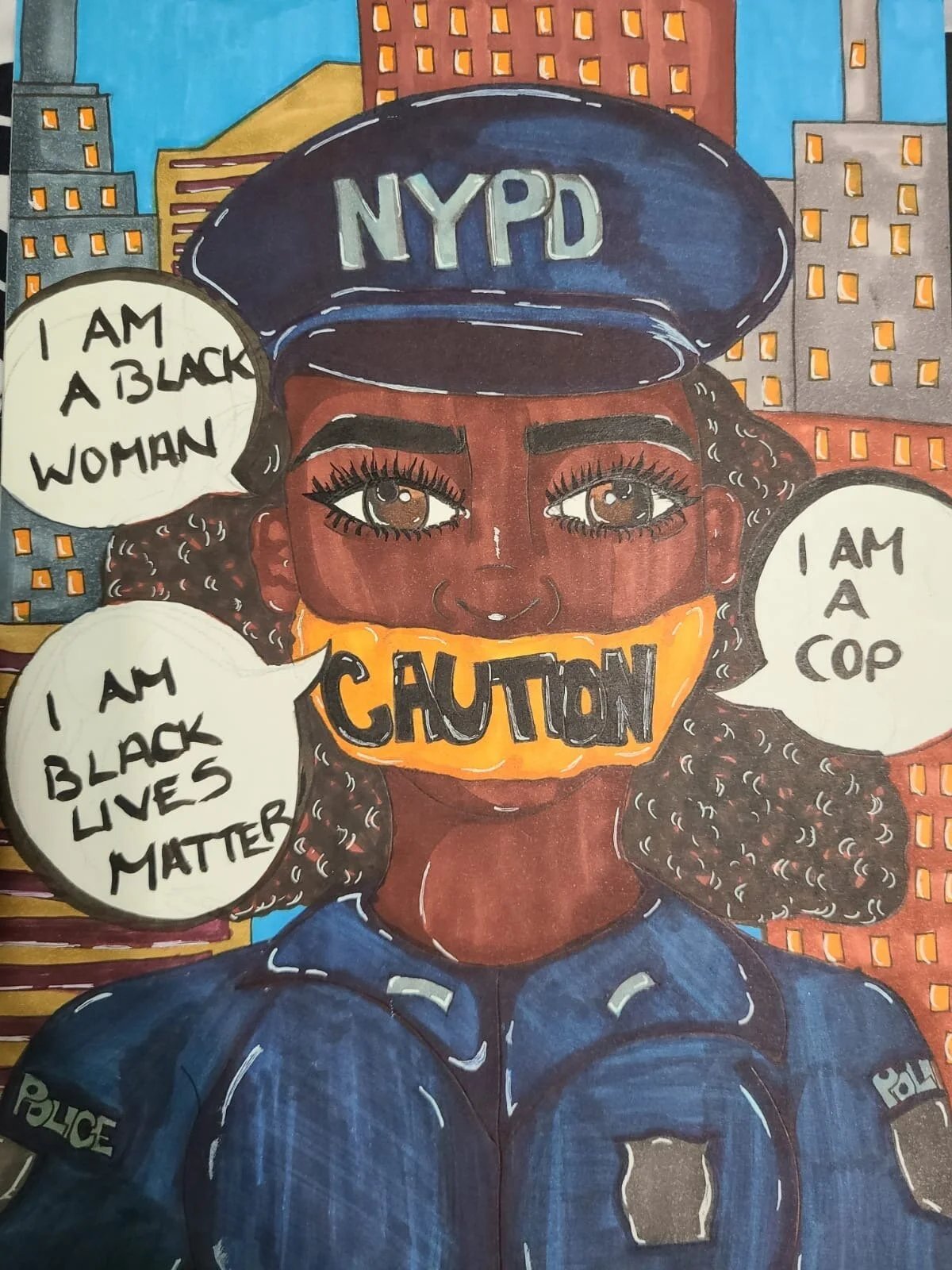
On May 25, 2020 the shocking death of George Floyd created outrage in the US along with the rest of the world. Throughout North America cities were overrun with a combination of peaceful police protests, rioting and looting. Caribbean Collective Magazine sat down with Jamaican-American New York Police Department (NYPD) officer, Lana Smith (whose real name we cannot use) to see a perspective that is quite often lost in the crossfire of policing and racial tensions. It’s the perspective of a Black female police officer. As North America continues the conversation on policing, we focus on Lana’s experiences policing one of the most eventful places in America – New York City.
What inspired you to become a police officer?
“ Initially I wanted to teach, but at the time I was finishing college teachers were being laid off and it was really hard to find a teaching job. I became a police officer. I was already on the waiting list. It was an option. I lived alone and I needed to pay my bills. Honestly, I don’t have a romantic ‘I wanted to be a cop my whole life story.’ My family is full of city workers. My mom was a correctional officer, I have family members who are higher ranking officers. It was the natural course of action.“
The past two months have been very hectic with racial tensions in the US. What has the atmosphere at work been like?
“ It’s kind of stressful because you have the whole police culture and what a lot of police officers believe. Then you have the whole conflict of being black at the same time and policing while black is a very difficult thing, it’s not simple at all.”
How do you balance being Black and being an officer?
“For me, I’m respectful to people. Even if I’m arresting somebody, I treat them with respect. I treat them as if it were me. Just because somebody messed up today doesn’t make them a horrible person, so I treat everybody with respect and dignity. That’s honestly how I navigate.“
What was your initial reaction when you heard about the murder of George Floyd?
“ I believe I was at work and I think my initial reaction was “oh shit, this is going to be bad.” We’re in one of those places where everything happens here –even if something didn’t happen here, there are going to be repercussions for it here. Then I actually saw the video. Initially I didn’t see the video, I only heard about it. It was a nightmare. It was heartbreaking, I was actually at home and I had just come from working and my old partner told me to turn on CNN and see what was going on. It was just pure insanity. On top of that they showed the video of the actual death of George Floyd.”
“My oldest son came into my bedroom and started watching CNN with me. He was like “why is that cop killing that guy?” I was like oh boy, I wasn’t ready to have this conversation with him now. I had to have the whole conversation about racism, systematic oppression, what it is to be Black in america. By the time I was 10 my mother had already had this conversation with me.”
“I had a conversation with him and then I was really pissed. I went through a whole range of emotions. I was angry because I felt like his innocence was being taken from him at that moment. I felt like it forced me into a space where I had to go into that space with him. He’s a Black male in America and I have to tell him. My husband is also a police officer and he’s always saying “I want to be a police officer” and “I’m like no you don’t. Please do something else.” I don’t want him to look at it and think it’s all he can do. I want him to know he has options.”
Have you been on duty at any of the Black Lives Matter protests? What has the environment been like?
“ For me it’s very irritating. It is majority young white people walking around screaming Black lives matter and flipping out on people and throwing bottles. I feel like they are stirring the pot and their opportunists and they just want to be a part of something. I don’t think they’re necessarily there because they care. You have them yelling Black lives matter to me and I’m Black. I’m like what do you know about it? For me it’s extremely aggravating because these are the same people who are going to scream Black lives matter so they can take pictures for instagram. That’s what I see them doing, I see them posing with signs taking photos”.
“You can’t say you’re an ally, somebody else has to say you’re an ally. So If you’re walking and you’re saying I’m an ally for Black people, I’m there with you. I renounce my white privilege. it doesn’t actually mean anything. What are you doing in society to help Black people out? It’s really upsetting. “
How do you feel about the concept of allyship? Do you feel it’s effective?
“No. I think everybody has reactions to things based on their life experiences and my life experiences with a lot of non-people of colour are that they care about things that affect them and that’s it. If these things don’t affect them, they don’t really care about them. Because of my experiences I don’t really believe a lot of people are actually the allies they’re trying to pretend they are. I feel like a lot of stuff is photo ops. All these companies are saying Black lives matter, we stand with you. It’s a picture they post on instagram, but what are they actually doing? Historically what have they done? A few years ago Marc Jacobs had all the models on the runway wearing bantu knots and they were calling them mini buns. It was so trendy. It’s a hairstyle that derived in Africa like what are you talking about? Still no credit was given. I just honestly don’t believe a lot of people. I want to see the work.”
“It’s very difficult. You try to have certain conversations at work and they don’t want to hear, they don’t want to have these conversations. I have coworkers who don’t want to hear it because they are extremely pro police. They’re generally white and they feel that these things aren’t happening to Black people. Then you have Black coworkers and you’re trying to have this conversation with them and they don’t want to make the white coworkers uncomfortable or they don’t want to have the conversations at all.”
Do you feel that co-workers and friends have looked to you for answers to their questions and validation?
“ I find that a lot of non-Black coworkers have their mind set anyway so they’re not looking for validation, they just feel like they are police. I have a lot of coworkers who just feel like they are cops. They can’t see themselves outside the uniform. Which to me is crazy, it’s confusing to me. I think a lot of people romanticize this job so much and they really honestly start to believe they are one with the uniform. They say “I don’t see colour”— that’s very insulting to me for you to tell me that you don’t see colour because im Black and I want you to know that. That’s the problem, you don’t see me.”
“I don’t think I have the typical police officer mindset. I really see myself outside of my job period. I see my job as a job and while I’m at work I do it to the best of my ability. I try to make people’s experiences with the police as pleasant or as regular as it can be. As soon as I take my uniform off at the end of my shift I’m done being a cop for the day. I already know what i’m going to do when I retire and I’m not going to retire for another decade. I already know what I’m going to do and I have people who can’t even see that far. They all want to move upstate or go up east. I’m leaving this country”.
Do you think the community reacts differently to you because you’re a black officer?
“Some people. Majority of the community sees me as a cop too. Majority of the community sees you the same way my coworkers do— they see you as one of them.”
Have you had any moments where you felt you no longer wanted to be an officer?
“Plenty. In all honesty if I could leave now I would. That had nothing to do with the world or society, it has to do with my job as a whole. I’ve had bosses start messing with my work schedule for no reason. I come into work and one day I’m working these hours and the next day you get a notification you’re working a different set of hours. A week later you’re working a different set of hours and there’s no rhyme or reason for it. Nobody’s telling you anything and you say something to them and they act as if it doesn’t exist or they act as if you believing it’s a personal attack is all in your head. It’s very frustrating.”
“You get bosses that don’t like you because you don’t look like them. I had a white boss who was always nonsense with him. While I’m very pro-Black and vocal about it, my partner at the time, we were two black women, wasn’t vocal about it because she felt she didn’t need to prove anything to anybody. So we had a boss who just used to mess with us. People’s response was “oh, he’s just racist.”
“I’ve had a boss come to me, my hair is very curly, very tightly curled, and I keep my hair cut because according to our guidelines your hair can’t be on your collar. I had a boss say ‘can you come into my office let me talk to you.’ I came into his office and he asked ‘what’s going on with your hair?’ I said ‘what do you mean?’ He said ‘it’s too large you need to do something about it.’ It’s having to deal with things like that at work.”
In your career, have you witnessed your colleagues discriminating against citizens?
“I’m very vocal so nobody’s stupid enouigh to do those things around me. People know people not to work with. Just because they haven’t done it in front of me, I know the people to stay away from”.
What do you feel could be done in the coming years to salvage the relationship between law enforcement and the public?
“ I do think there are a lot of things that can be done. I know my job is working on things, whether they be from a place of purity or a place of necessity and force, things are being done. We do have some really good leaders in my job, I don’t want to call them bosses, we have bosses and then we have leaders. They are coming together and trying to brainstorm and come up with ideas of what we can do. I think it’s great, I think it’s necessary, I think it’s overdue.”
“We already have a lot of programs with the community so they’re trying to revamp these programs and try to really see what certain communities need and what we can do to lend a helping hand to these communities. Let’s see though. Let’s see what happens. There’s a lot of changes happening right now. Hopefully in the next few months some of these programs get off the floor and hopefully they’re successful.”
While we’ve seen many negative interactions between the police and the public intensify in the last 6 months it’s important to note that black female cops often find themselves at a crossroad between being a cop and being black women. It’s a perspective not talked about enough. Studies have shown that diversity oftentimes adds to heterogeneous thinking in the work environment across industries. Women leaders are said to exhibit more characteristics of empathy. We can’t help but wonder: if there were more women of color in law enforcement would racial tensions be as high? Think about it. What’s your opinion?