

Before Keisha Bissram’s “Black Cake” became a story about two sisters, grief and the weight of family tradition, she was trying to tell stories that would make her acceptable to a broad audience. She wanted to prove she belonged. But the work became more meaningful when she stopped trying to convince everyone and began drawing more deeply from the world she knew.
That world was a Trinidadian household on Staten Island, surrounded by parents, sisters, cousins, aunts, uncles and grandmothers. It was full of food, music, love and a distinctly familiar way of speaking. It was also a place where survival and the pursuit of stability could leave little room for emotional support.
View this post on Instagram
Now an actor, writer, filmmaker, producer and comedian based in Los Angeles, Bissram brings those layers into stories that give Caribbean women something she rarely saw growing up: permission to be complicated.
I want Caribbean women to feel recognized rather than explained, she says.
As a child, Bissram found the closest reflections of herself in “Taina,” “Sister, Sister” and Bollywood films. At 23, when she began studying acting at The Barrow Group in New York, the lack of representation became harder to ignore. She questioned where someone with her appearance and background was supposed to fit. Rather than wait for an answer, she began writing short films and created the web series “Conversations in Apartment 3A.” The series did not become what she had hoped, but it established an impulse that continues to guide her work.
If no one is going to give me an opportunity, I will create one for myself.
There were practical limits. Returning to school for film was not realistic when she needed a stable income and security. There were emotional barriers, too. Despite growing up surrounded by family and community, she sometimes struggled to find the encouragement she needed to imagine a future in the arts.
[Additional Read: Phoenixx Rocks: The Brooklyn-Born, Jamaican American Artist Making Music With Purpose ]
Those experiences did not diminish her desire to tell stories. They helped clarify whom she wanted those stories to reach.
For Bissram, representation is not simply putting an Indo-Caribbean woman onscreen. It is allowing that woman an inner life beyond the cultural details that make her recognizable. Her characters can be ambitious, loving, selfish, grieving, funny or unsure of themselves. Their identities matter without becoming the only thing that matters.
We can be funny without being the sidekick and vulnerable without being viewed as weak, she says.
That philosophy took shape in “Black Cake,” which grew out of conversations with her friend Megan Channell, a collaborator on “Conversations in Apartment 3A.” They had been developing another project when Bissram proposed a story about two sisters navigating grief. The food at its center was initially going to be roti or another traditional dish. Eventually, they settled on black cake.
For Bissram, the cake held the history, memory and strong opinions that gather around a family recipe. It became a way to explore what happens when two people love the same family but disagree about how to carry its legacy forward.
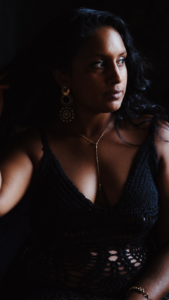
Photo courtesy of Denisse Monge
The sisters, Sherry and Meena, process loss differently. One wants to preserve the family home and what it represents. The other wants to move forward, even if that requires letting go. Their conflict asks a question that extends beyond a house or a recipe: Does honoring a tradition mean keeping it unchanged or making room for it to evolve?
Although the emotional story is fictional, its details come directly from Bissram’s upbringing. Her mother and cousins inspired the characters’ mood boards, with family photographs, outfits and colors informing their appearance. Props and styling details came from her parents’ home and stores along Liberty Avenue in Queens. Real family photographs helped give the film’s home a sense of lived history.
The cake itself follows her mother’s recipe. Her mother also helped teach the director how to make it.
Then there is the music.
Every Christmas, Americans have ‘All I Want for Christmas Is You, Bissram says. In my family, we have ‘Yvonne.’ That is Christmas to me.
These details ground the film in a particular family rather than asking it to stand for every Indo-Caribbean experience. Bissram wants that distinction to matter. No single character, she says, should have to represent an entire culture.
View this post on Instagram
Her insistence on individuality also informs her approach to colorism, beauty standards, dating and ambition. Bissram describes experiencing bullying within her family and community, as well as while growing up on Staten Island. She witnessed differences in how relatives were treated based on skin color and carried some of those messages into her own assessment of what she deserved.
I have turned down opportunities because I genuinely believed I was not good enough and that someone else deserved them more than I did, she says.
She acknowledges the supportive people in her community while refusing to dismiss the harm. Her work makes room to question expectations that women remain accommodating, endlessly giving and responsible for everyone else.
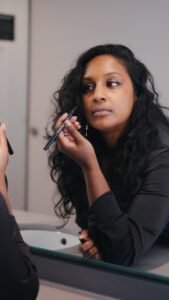
Photo courtesy of Denisse Monge
Comedy offers another way into those conversations. Onstage, Bissram can speak directly about family, dating, identity and the absurdity of expectations placed on Caribbean women. Where acting lets her communicate through a character and writing lets her determine whose perspective drives a story, stand-up gives her an immediate exchange with an audience.
Across those forms, she wants to acknowledge pain without making struggle the defining feature of Caribbean womanhood.
Asked what she wishes she had seen onscreen growing up, Bissram turns first to what she wishes she had seen in life: women treated with tenderness, supported in their choices and able to rest because someone was caring for them, too.
Those hopes shape what she wants the next generation to understand.
I want an Indo Caribbean girl to know she does not have to shrink, translate herself or wait for permission to belong in the story.
Bissram is continuing to build toward that vision. “Black Cake” won Best Family Drama at the 2026 Toronto International Nollywood Film Festival. She is pursuing screening opportunities and future distribution.She also recently produced and starred in the espionage short film Spotter, which was in postproduction at the time. which was in postproduction at the time. She continues to develop new projects, perform stand-up and pursue acting.
Her ambitions extend beyond grounded drama. She wants Caribbean and Indo-Caribbean women in comedies, thrillers, horror films, romances and action stories, with identities that are present without always driving the entire plot.

Photo courtesy of Denisse Monge
Getting there, she believes, requires more than the right agent or a gatekeeper’s approval. It requires writers, producers, executives and audiences willing to support the work, along with community relationships that translate into attending screenings, buying tickets and sharing stories.
Bissram does not claim to have a single formula for visibility. What she has is a commitment to keep creating and a refusal to make herself smaller while waiting to be understood.
We deserve the serious drama, she says, but we also deserve the absurd comedy, the action sequence, the romance and the ridiculous adventure.
Learn more about Bissram and her work on her website.