
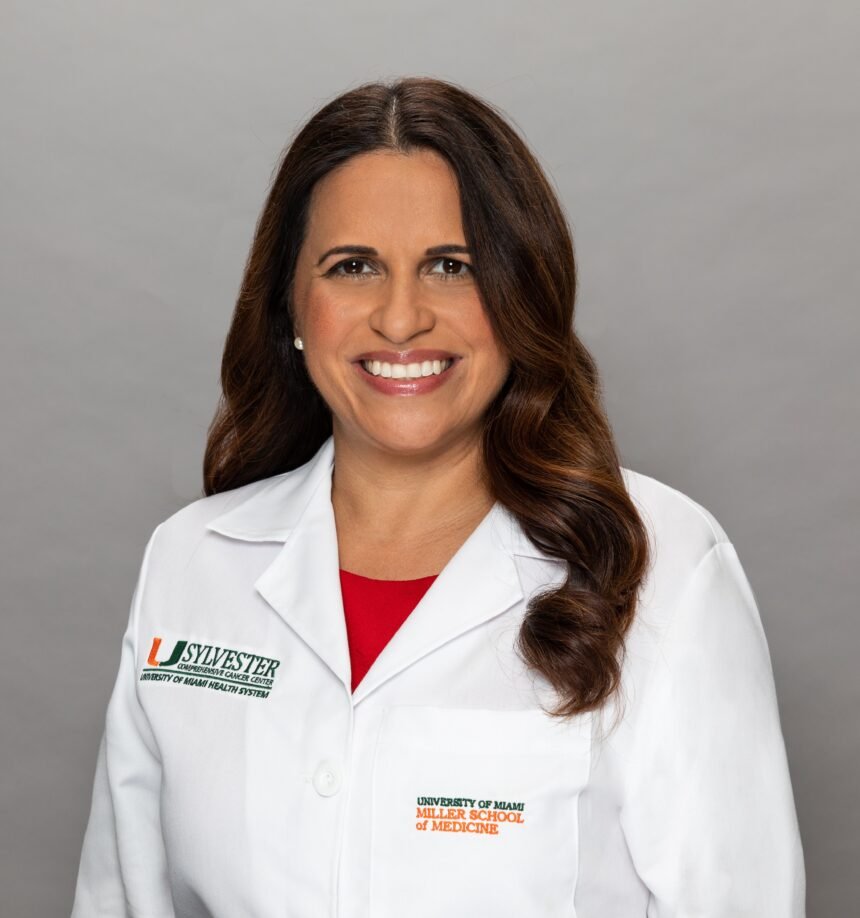
Dr. Estelamari Rodriguez did not set out to become a national voice for Latino cancer patients. She set out to understand why her grandmother, who survived cervical cancer in Puerto Rico, never fully understood her own diagnosis or treatment. That question shaped a career that now spans clinical research, community outreach and mentorship at one of the country’s top cancer centers. Rodriguez is a triple board-certified hematologist and oncologist at Sylvester Comprehensive Cancer Center in Miami, part of the University of Miami Miller School of Medicine.
- Growing Up in Guaynabo
- She watched this play out with her own grandmother, who had cervical cancer and later died of complications from diabetes and heart disease in her early 60s. A child, a neighbor or someone from church always accompanied her grandmother to medical visits, Rodriguez said.
- That is how I was raised to understand illness, Rodriguez said. Faith and community, she added, were central to that upbringing.
- A Grandmother’s Cancer Sparked a Career
- [Additional Read: Gen Z Founder Dalise Lockhart on Inspiration, Identity and Inclusivity ]
- Being the Only Latina in the Room
- You develop a low hum of self-doubt, the sense that you have to be twice as prepared to be taken half as seriously, Rodriguez said.
- The most rewarding moments happen when those two halves meet, Rodriguez said, such as when a patient from a community historically excluded from research ends up on a trial that helps them, even when other doctors assumed that patient could not follow a complicated phase 1 protocol.
- Why Cultural Fluency Builds Trust
- Trust is not a soft outcome, Rodriguez said. It is a clinical one.
- Representation Determines What Gets Studied
- First, patients do better when they are understood. Latino patients are diagnosed with lung cancer at later stages, go untreated more often and remain significantly underrepresented in clinical trials, she said. Some of that gap comes down to access, but much of it comes down to trust, which is built by people rather than pamphlets.
- Many lung cancer medications in use today, Rodriguez noted, were approved based on trials that included only a small number of Latino participants.
- Her Advice to the Next Generation
- You belong in the room before you feel like you belong in the room, she said. The feeling comes later, and for some of us it comes very late. Do not wait for it.
- The accent, the family, the culture, none of those are obstacles to being an excellent physician, Rodriguez said. In my work, they are the reason I am good at it.
- Looking Ahead
- A Folkloric Dancer Before a Public Speaker
- That kind of pride and joy is priceless, Rodriguez said.
Rodriguez serves as clinical research lead for thoracic oncology and associate director of community outreach and engagement. She talked about growing up in Guaynabo, Puerto Rico, the isolation of being “the only one” in rooms across Ivy League institutions, and why representation in medicine is not about optics but about whether the science itself is complete.
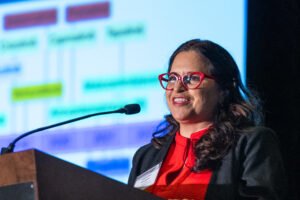
Growing Up in Guaynabo
Rodriguez said her Puerto Rican upbringing gave her a framework she carries into every exam room: family as the primary support system, and an expectation that people take care of their community because their community took care of them.
She watched this play out with her own grandmother, who had cervical cancer and later died of complications from diabetes and heart disease in her early 60s. A child, a neighbor or someone from church always accompanied her grandmother to medical visits, Rodriguez said.
Today, when a patient arrives with a daughter, sister and neighbor crowded into the exam room, it feels familiar. She sees the same kind of care system she grew up with.
That is how I was raised to understand illness, Rodriguez said. Faith and community, she added, were central to that upbringing.
A Grandmother’s Cancer Sparked a Career
Rodriguez’s grandmother survived cervical cancer, treated in an era when Puerto Rico used cobalt radiation. But she never fully understood what caused her cancer, how it might have been prevented or the long-term effects of the treatment she received.
That silence, and the language and educational barriers so many patients face, pushed Rodriguez toward oncology and clinical research. Stigma and fear, she said, still limit how people access treatment, prevention and survivorship care. Medical vocabulary can compound the problem, even when a doctor and patient technically speak the same language.
Two facts drove her into research specifically: Latino patients make up fewer than 10% of participants in major cancer registration trials, and Rodriguez believes the hope that research offers has to reach every patient, regardless of language, education or insurance coverage.
[Additional Read: Gen Z Founder Dalise Lockhart on Inspiration, Identity and Inclusivity ]
Being the Only Latina in the Room
As a first-generation student who attended an Ivy League university and medical school, Rodriguez said she arrived without a map. Nobody in her family had gone to medical school before her, so she did not know how to ask for a research position, how mentorship worked or that she was allowed to knock on a professor’s door.
She learned by watching classmates who had grown up around those systems, a stark contrast to her Catholic school education in Puerto Rico, where questioning authority was not encouraged.
Rodriguez also described the loneliness of being the only Latina, and sometimes the only woman of color, in rooms in New York and Philadelphia, even later in her career as an academic lung cancer physician.
You develop a low hum of self-doubt, the sense that you have to be twice as prepared to be taken half as seriously, Rodriguez said.
She worried people would not understand her accent at the podium and carried a persistent feeling of not belonging. What helped her push through, she said, was refusing to face it alone. She got involved early with Latino student associations, including the Latino Medical Student Association, and with the Latinas in Medicine community online. Her later work as former assistant director for diversity, equity and inclusion at Sylvester Comprehensive Cancer Center grew directly out of those early experiences.
View this post on Instagram
Two Roles, One Mission
Rodriguez’s current work connects clinical research with community care.
As clinical research lead for thoracic oncology, she helps build and run the cancer center’s trial portfolio, ensuring patients have access to treatments that are genuinely new rather than simply available.
As associate director of community outreach and engagement, she works to ensure Sylvester Comprehensive Cancer Center serves the community around it. South Florida has one of the most diverse patient populations in the country, she said, which means going out into that community rather than waiting for people to come to an academic medical center.
The most rewarding moments happen when those two halves meet, Rodriguez said, such as when a patient from a community historically excluded from research ends up on a trial that helps them, even when other doctors assumed that patient could not follow a complicated phase 1 protocol.
Why Cultural Fluency Builds Trust
Speaking Spanish matters, Rodriguez said, but cultural connection goes further. It means understanding why a patient hesitates before agreeing to a trial, recognizing the role faith plays in a family’s decisions, and knowing when a patient is saying yes out of deference rather than genuine agreement.
In many Latino families, she said, a diagnosis gets discussed with the whole family before the patient responds. There is often an informal health expert in the network, whether that is a granddaughter who works as a nurse, a student, a neighbor or a faith leader.
When patients see a physician who looks like them and understands where they come from, Rodriguez said, the conversation starts differently. Patients ask better questions and are more honest about whether they are actually taking their medication.
Trust is not a soft outcome, Rodriguez said. It is a clinical one.
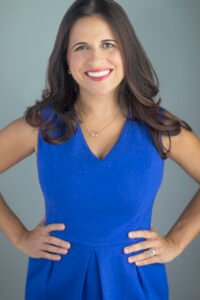
Representation Determines What Gets Studied
Rodriguez pointed to two practical reasons why representation of Puerto Rican and Latina physicians in medicine and research matters.
First, patients do better when they are understood. Latino patients are diagnosed with lung cancer at later stages, go untreated more often and remain significantly underrepresented in clinical trials, she said. Some of that gap comes down to access, but much of it comes down to trust, which is built by people rather than pamphlets.
Second, who conducts the research shapes what gets researched. If Latino physicians and scientists are not in the room, the questions that matter most to their communities do not get asked, and the trials that follow do not enroll enough Latino patients to know whether treatments work as well for them.
Many lung cancer medications in use today, Rodriguez noted, were approved based on trials that included only a small number of Latino participants.
View this post on Instagram
Her Advice to the Next Generation
Rodriguez’s guidance to young Puerto Rican and Latina women considering medicine, research or healthcare leadership starts with a simple idea: belonging comes before the feeling of belonging does.
You belong in the room before you feel like you belong in the room, she said. The feeling comes later, and for some of us it comes very late. Do not wait for it.
She encouraged young women to ask for what they need, since first-generation students are often too polite to ask in a field that rewards those who do. She also urged them to find mentors both inside and outside their institutions.
Rodriguez pushed back on the idea that professionalism means erasing where you come from. For years, she said, she thought it meant toning down her clothing, her accent and her warmth. She has since learned the opposite is true.
The accent, the family, the culture, none of those are obstacles to being an excellent physician, Rodriguez said. In my work, they are the reason I am good at it.
Looking Ahead
Rodriguez remains focused on expanding access to thoracic oncology clinical trials for South Florida communities and on the outreach work that makes that access possible.
She is also invested in building a pipeline for future physicians through her work with the Latino medical community, so that the next generation does not have to navigate medicine alone the way many before her did.
Her long-term goal is straightforward: eradicate lung cancer disparities in diagnosis and treatment and improve outcomes for minority patients. That will require earlier detection, better access, expanded insurance coverage, education and clinical trials that actually enroll Latino patients.
A Folkloric Dancer Before a Public Speaker
Before she grew comfortable speaking at medical conferences, Rodriguez learned to feel at ease on stage in a different way: dancing with the Puerto Rican folklore group Gibaro.
As a high school student, she toured Europe twice with the group, an experience she calls one of the most formative of her life. Representing her country through dance and watching how deeply the music moved audiences still inspires her today.
That kind of pride and joy is priceless, Rodriguez said.
To learn more about Dr. Rodriguez and the work she is doing, click here.