
For Caribbean women, history is often something we inherit before we fully understand it. It lives in our family stories, traditions, food, languages and the places our ancestors came from.
But what happens when we move beyond learning about that history and actually walk through it?
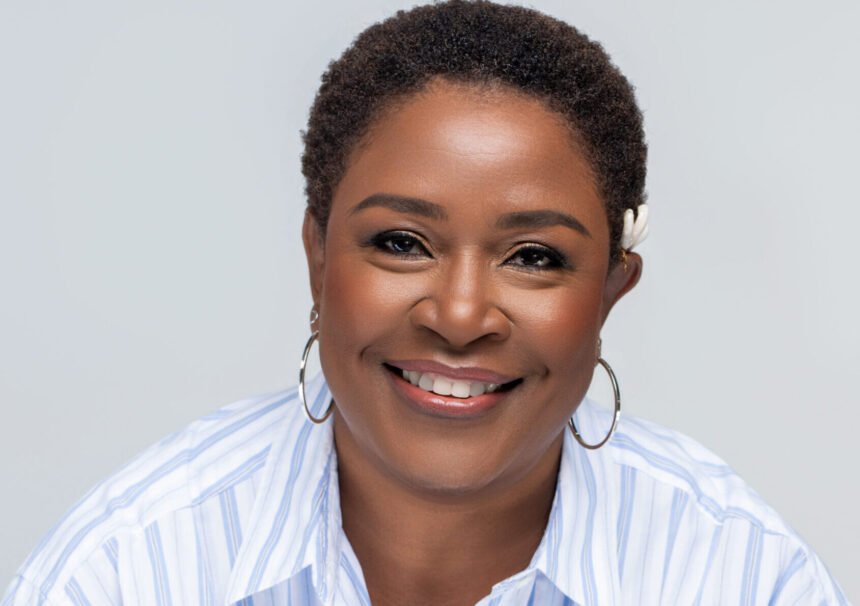
For Haitian American entrepreneur and Cultural Historian Ambassador Guerline T. Emmanuel, that question has become central to her work. Through Belle Vue Tours, the Haiti-focused travel company she founded with her husband, Hogarth, she has spent years creating journeys that encourage people to experience Haiti through its history, culture and people.

Now, she is taking that idea further with the Legacy Tour: Three Continents, One Story, a one-time journey connecting Africa, Europe and Haiti.
We want people to understand that these are not separate stories. They are connected chapters of our history, Emmanuel says. The Legacy Tour is about physically tracing those connections, honoring our ancestors, and helping the diaspora understand that ancestry is not just something symbolic; it is our shared identity and story that we can actually walk through and experience.
Emmanuel is particularly passionate about encouraging Caribbean women to experience Haiti because of the connections that exist across the region.
For Caribbean women especially, these journeys are important because of our shared history, culture, and identity, she says. We share a bond not only through our history and culture, but through our ancestry and DNA, because of the circumstances and history that brought the vast majority of us to the Caribbean.
She has seen what happens when people encounter those connections firsthand.
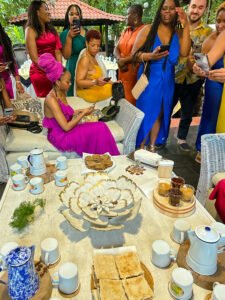
Belle Vue Tours guests gather for a garden brunch
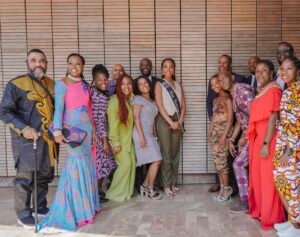
Tour group with Belle Vue Tours
[Additional Read: The Hakka People of Jamaica: How One Woman is Refusing to Let Her People be Forgotten ]
During one journey, Emmanuel watched African Americans, Belizeans, Jamaicans and, in particular, Grenadians visit Palais Sans-Souci, the historic Haitian site associated with Henry Christophe, who had been transported to Saint-Domingue from Grenada.
I had the pleasure of watching African Americans, Belizeans, Jamaicans … and especially my Grenadian sisters touch Palais Sans-Souci, she recalls. In that moment, you could feel that our stories are intertwined.
For Emmanuel, that moment captured the importance of experiencing history in person.
I believe physically experiencing these places creates a connection to history that you simply cannot get from reading about it, she says. A Caribbean woman can discover how deeply her identity is connected to Haiti and the wider Caribbean.
Her own relationship with Haiti began long before she created Belle Vue Tours.
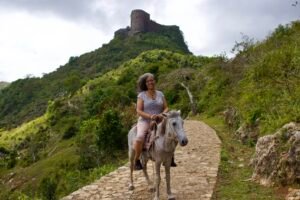
A traveler rides toward the Citadelle Henry in Haiti
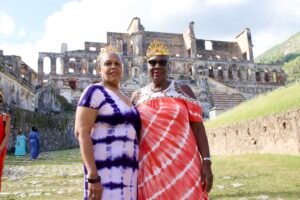
Travelers at Palais Sans-Souci
Born in Haiti, Emmanuel moved to the United States at age 8 but remained connected to the country through her family. Her father kept Kreyòl alive in their home and introduced her to Haitian history, music, plays and football.
Years later, returning to Haiti with her own family became a process of what she calls “re-education.”
After the 2004 coup, Emmanuel returned to Haiti and was struck by the difference between what she experienced and what she heard in U.S. media.
For me, re-education meant learning to look beyond the narrative and understand what was behind it, she says. Before accepting any narrative, you have to understand who created it, who controls it, and who benefits from it.
That experience shaped how she raised her children and, ultimately, the work she chose to build.

Cannonballs line the trail at the Citadelle Henry
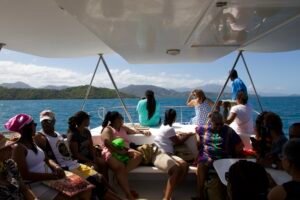
Guests take a boat excursion
On one family trip, her younger child looked around Haiti and said, “You never told me Haiti was a paradise.”
For Emmanuel, it was a turning point.
I realized that if my own children can understand Haiti beyond the narrative, I had a responsibility to help others experience it that way too, she says.
Emmanuel believes reconnecting with Haiti and other places tied to Caribbean history can change how people across the region understand themselves.
The Caribbean brought together people from different nations, kingdoms, cultures and traditions. Despite the disruption of slavery and colonialism, ancestors carried knowledge, beliefs, skills, creativity and traditions with them. Those influences became the cultures of the Caribbean.
Our story is not just one of displacement, Emmanuel says. It is also a story of fusion, creation, and the remarkable cultures we built from the many threads of who we are.
That is what she hopes the Legacy Tour will help people see. Africa, Europe and Haiti are not simply destinations on a map. They represent connected parts of a history that shaped the Caribbean and its diaspora.

Emmanuel with The Liberators luggage
For Caribbean women in particular, Emmanuel believes understanding those connections can offer something deeper than knowledge: recognition.
The ties that bind us are strong, she says. You see yourself within that history because the people and events are also part of your ancestry.
For Emmanuel, owning that history is also a responsibility.
I believe my larger purpose is to take responsibility for my country, honor my ancestors’ legacy, and add to what they left us.
Her hope for the next generation of Caribbean women is that they will understand that knowing where they come from does not mean living in the past.
We don’t have to choose between honoring the past and creating the future; we can do both, she says. Most importantly, I want them to understand that they have a voice and the power to own their narrative. Know who you are, know where you come from, and don’t be afraid to build from it.
About the Guest Author
Kinisha Correia is the founder of About Her Culture, an independent platform documenting the stories, contributions and experiences of Caribbean women across the region and its diaspora. The platform highlights women around the world who are shaping Caribbean culture, leadership, entrepreneurship and social change. Her work is driven by a commitment to preserving the region’s stories and expanding how Caribbean women’s experiences are represented.
Website: https://aboutherculture.com
Instagram: @aboutherculture