
Grenada-raised, Trinidad-shaped and now based in Ontario, Canada, the painter behind “Girl on Fire“ talks migration, empowerment and why the art world still isn’t seeing Caribbean women clearly.
- [Additional Read: Phoenixx Rocks: The Brooklyn-Born, Jamaican American Artist Making Music With Purpose ]
- Roots in Grenada, Awakening in Trinidad
- In Grenada I was just an observer of womanhood through an archaic-looking glass, she said. Women as mothers, storytellers, teachers and protectors. Yes, they were the backbone of our culture, but we were more than just a witness. We had to be.
- What Empowerment Actually Looks Like on Canvas
- It is women claiming their willpower, survival and expression of their inner sanctum, she said. Empowerment in my practice becomes a mirror of emotional truth. I want viewers to walk away with a sense of permission to feel deeply, and to be unapologetically themselves.
- Inside ‘Girl on Fire‘
- It is a piece that holds special significance to me because it is about an emotional burning that doesn’t destroy her but strengthens her, she said. The fire in the painting represents both anxiety and fear, and also the strength that comes with awakening and personal power.
- Empowerment isn’t always gentle or quiet. It’s a woman deciding that she will no longer bear what is not hers to bear, as the fire burns it away. It’s a shift from internal struggles to external radiance.
- The Stories the Global Art World Still Overlooks
- My art challenges the global narrative with metaphors, she said. We inherited stories of resistance and spirituality, so why not carry that flame on.
- Balancing Vulnerability and Strength
- From Tote Bags to Transformation
- In doing this I give other women permission to do the same, Francis said.
- Building Infrastructure, Not Just Visibility
- When I moved to Canada, I didn’t see myself in much, she said. I decided to be that visibility that I didn’t have. This magazine is doing that. It’s amplifying the voices of Caribbean women globally, and we need more digital platforms recognizing Caribbean hybridity as a strength within the diaspora.
- Teaching Beyond Technique at AFFA Studio
- That as a diverse world, we don’t have to shrink to be accepted, she said. Art is a powerful tool to process and understand their emotional world, and shows that vulnerability is not weakness.
- What Comes Next
- So look out for my quality art supplies, coming soon to an art store near you, she said.
For painter Angela Francis, art has never been about decoration. It is about telling the truth, even when that truth is uncomfortable, complicated or still being figured out.
Francis grew up between Grenada and Trinidad before eventually settling in Ontario, Canada, and each place left its mark on the way she paints women. Her work centers on the emotional and psychological lives of Caribbean women, moving away from the postcard imagery so often associated with the region and toward something more introspective. In this interview, she opens up about the memories that shape her art, the meaning behind her piece “Girl on Fire,“ and why she believes the global art world still has work to do when it comes to recognizing Caribbean women as intellectual and conceptual artists, not just colorful ones.
[Additional Read: Phoenixx Rocks: The Brooklyn-Born, Jamaican American Artist Making Music With Purpose ]
Roots in Grenada, Awakening in Trinidad
Francis said her earliest understanding of womanhood came from watching the women around her in Grenada.
In Grenada I was just an observer of womanhood through an archaic-looking glass, she said. Women as mothers, storytellers, teachers and protectors. Yes, they were the backbone of our culture, but we were more than just a witness. We had to be.
That observation turned into something more active once she moved to Trinidad, a period she describes as a turning point. Intellect, culture and activism collided there, pushing her away from classical figurative training and toward symbolic work rooted in narrative. Opening her eyes to the political and social realities facing women became, in her words, the root of her empowerment themes.
Her move to Ontario added another layer entirely. Rather than pulling her away from her Caribbean identity, she said, Canada sharpened it.
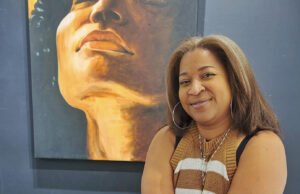
Photos courtesy of Xan Lazaridis 2026
“Canada didn’t dilute my Caribbean heritage. It clarified it. It clarified my narrative of identity and liberation,” Francis said. Living abroad pushed her to dig into memory and transformation through the lens of migration and to ask harder questions about who she is outside of family, culture and inherited labels.
What Empowerment Actually Looks Like on Canvas
Ask Francis to define empowerment and she does not reach for a slogan. She describes it as an evolved state, one where a woman recognizes her own complexity and claims the freedom to take up space.
It is women claiming their willpower, survival and expression of their inner sanctum, she said. Empowerment in my practice becomes a mirror of emotional truth. I want viewers to walk away with a sense of permission to feel deeply, and to be unapologetically themselves.
That philosophy shows up in the emotional territory she returns to again and again: self-love, grief, serenity, strength and resilience. Vulnerability, she said, functions almost like a form of truth-telling, and it is often where real strength begins. Sensuality, too, plays a role, not as spectacle but as self-ownership. A tilted head or the curve of a shoulder becomes, in her paintings, a kind of language.
Inside ‘Girl on Fire‘
Among her body of work, one piece carries particular weight for Francis: “Girl on Fire,” created during the COVID-19 pandemic.
It is a piece that holds special significance to me because it is about an emotional burning that doesn’t destroy her but strengthens her, she said. The fire in the painting represents both anxiety and fear, and also the strength that comes with awakening and personal power.
Francis is quick to point out that the painting is not a quiet one. Its subject’s posture carries both emotions at once, tension and release.
Empowerment isn’t always gentle or quiet. It’s a woman deciding that she will no longer bear what is not hers to bear, as the fire burns it away. It’s a shift from internal struggles to external radiance.
The Stories the Global Art World Still Overlooks
Francis believes there is a specific gap in how Caribbean women are represented internationally, and she counts herself among the artists working to close it.
“The global art world often celebrates the vibrancy of our carnival culture and our landscape, but rarely the emotional, intellectual inner lives of our women,” she said. She points to a shared but distinctly Caribbean experience: living between places, the ache of leaving and the joy of returning, and constantly renegotiating identity across cultures, almost like a chameleon.
She also described a quiet resilience carried in the posture of Caribbean women who hold up their families and their culture while still nurturing their own ambitions, often within a culture that still misunderstands or exoticizes women owning their sensuality.
My art challenges the global narrative with metaphors, she said. We inherited stories of resistance and spirituality, so why not carry that flame on.
Balancing Vulnerability and Strength
For Francis, vulnerability is not the opposite of strength. It is the starting point.
“Bravery is not the absence of fear, it’s being afraid and doing it anyway,” she said. Painting from lived experience means sitting with discomfort, but she is careful to frame the work as something other than airing wounds publicly. It is closer to a personal record: this is what she felt, what she lived and what shaped her.
“You cannot be a true artist if you cannot be true to yourself,” Francis said. She described vulnerability and strength as two forces that do not fight each other but instead hold a conversation. A piece typically begins with vulnerability, and strength emerges as the painting takes shape, sometimes through a bold gesture, sometimes through a fiercer concept. “The balance is what makes my work resonate with women. I create a sort of alchemy where I take the internal and make it communal and powerful.”
From Tote Bags to Transformation
Francis’s relationship with art started long before she had language for what she was doing. As a child, she built a dollhouse out of a bookshelf, made furniture from matchboxes and designed outfits for paper dolls. By age 15, she was selling art to tourists at a hotel in Grenada, hibiscus flowers and coconut trees painted on tote bags and T-shirts.
View this post on Instagram
Over time, the work shifted from creative play to genuine self-inquiry. “It’s not just a mirror for me but also for other women who carry similar aspects of my identity,” she said. Grief, longing, fear, love, anxiety, strength, sensuality and resilience all became subjects. Eventually, healing itself became the theme, expressed through empowerment and what she calls a refusal to shrink.
In doing this I give other women permission to do the same, Francis said.
Building Infrastructure, Not Just Visibility
When asked what needs to change for Caribbean diaspora artists, Francis did not hesitate. She wants critics and institutions to engage with Caribbean art as intellectual, conceptual and philosophical work, not simply as vibrant and colorful surface aesthetics.
“I’d like to see a shift from tokenism, the vibe and surface-level fascination, to genuine cultural respect: politics, heritage, symbolic narratives,” she said. She noted that she is often invited to participate only during heritage months or themed exhibitions, rather than being included as a matter of course.
Her wish list includes long-term funding to address the challenges of displacement and migration, along with international residencies designed specifically for Caribbean diaspora artists. She also wants to see more curators and selection committees who genuinely understand Caribbean culture.
Francis has already started building that infrastructure herself, serving as a juror for Black youth art shows and mentoring young Caribbean women trying to break into the art world.
When I moved to Canada, I didn’t see myself in much, she said. I decided to be that visibility that I didn’t have. This magazine is doing that. It’s amplifying the voices of Caribbean women globally, and we need more digital platforms recognizing Caribbean hybridity as a strength within the diaspora.
Teaching Beyond Technique at AFFA Studio
Outside her own practice, Francis teaches through AFFA Studio, which she describes as far more than a class location.
“It’s more of a community, a place where it’s a safe space where people can have permission to be themselves,” she said. Her goal for students goes beyond artistic skill. She wants them to feel their voice is valid, to explore with intuition and to build genuine acceptance, growth and love of themselves and others.
That as a diverse world, we don’t have to shrink to be accepted, she said. Art is a powerful tool to process and understand their emotional world, and shows that vulnerability is not weakness.
What Comes Next
Francis is not slowing down. She plans to expand her symbolic vocabulary, building on earlier work centered on Caribbean female historical figures and the women who shaped her own understanding of strength. She described an emerging cohesive arc mapping her own evolution, moving into what she calls a transition phase and eventually a future phase, marked by bolder symbolism and more unapologetic narratives.
She is also planning to work at a larger scale, both literally and conceptually, moving into 3D sculptural pieces and mixed media that reflect women taking up more physical space in the world, not just conceptual space.
And her ambitions extend beyond the canvas. Francis recently began developing art kits as part of a broader brand expansion tied to AFFA Studio.
So look out for my quality art supplies, coming soon to an art store near you, she said.
To learn more about Francis and her work visit her website here.