
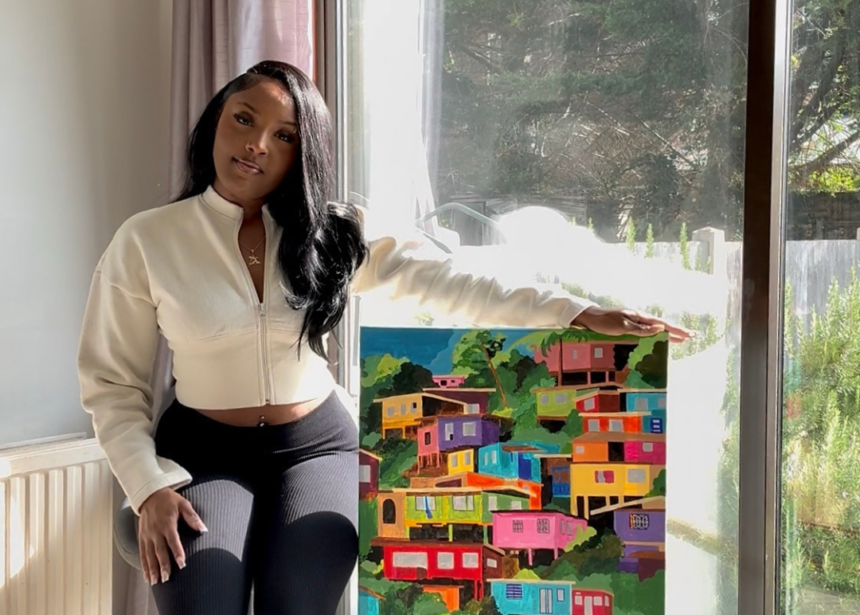
Tiyana Duberry paints the ordinary things she finds beautiful in the Caribbean. She wants anyone who hangs her work to feel the sunshine of the islands in their own home.
Art did not come easily at first. Duberry studied it for her GCSE , a UK qualification typically taken around age 16. She quickly learned her creative artistry could become stifled when working for someone else’s and having it judged from their preferences and perspective. So she stopped making art for two years.
[Additional Read: The Hakka People of Jamaica: How One Woman is Refusing to Let Her People be Forgotten ]
In 2018, she returned to art with and interest in intricate pattern drawings. While she enjoyed them, they never fully resonated with her because she loves colour. The real shift came in 2023, after a summer in the Caribbean. She photographed things she found beautiful that others saw as ordinary, then began to paint what she saw.
It felt like everything was aligned and that this is what I should have been doing all along, she says.
Her style is bold, bright and vibrant, and that is deliberate. To Duberry, the UK can feel mundane, uniform and grey, so she paints the opposite. She wants buyers to feel a moment of being in the Caribbean anytime they look at her paintings.
Moko jumbies, soca and the beach appear throughout her work. She credits Trinidad and Montserrat with helping her find her voice and shape her style.
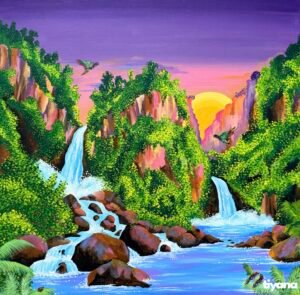
Trafalgar Falls — Acrylic on Canvas, 60 × 60 cm — Tiyana Duberry
Duberry visited the Caribbean often as a child and again as an adult. Each trip felt different, and her most recent visits fully awakened the artist in her. She felt a deep sense of gratitude and wanted to put it on canvas.
Her painting “Pieces of Paradise” captures that feeling. It highlights the diversity, resilience and spirit of Caribbean people. Much of her work centres on Trinidad and Montserrat because her parents are from there. She also paints scenes inspired by other islands so more people can share in that pride.
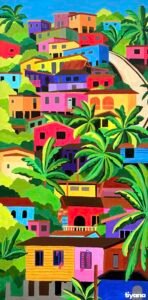
Up the Hill — Acrylic on Canvas, 50 × 100 cm — Tiyana Duberry
When an idea arrives, Duberry checks her camera roll first. Nine times out of 10, she finds a matching photo. If not, she searches Google or Pinterest for a reference. She then adds her signature elements in Photoshop and sketches the piece.
The finished painting never matches the reference exactly. I kind of like it that way, she says.
Her biggest obstacle is what she calls art paralysis, a more intense version of art block. She has so many ideas that choosing the next one is difficult. She dislikes unfinished work, but says that if her brain had its way, she would have about 11 half-started paintings.
Her solution is to plan carefully and commit to one painting at a time.
View this post on Instagram
After years of artistic modeling and growth Duberry finds herself with requests. This year, two therapists approached the artist to illustrate their new wellness products: interactive colouring books built around mindfulness. She says the project meant a lot because her work had resonated with them.
She paints only what she loves, not what she thinks will sell. The project showed her that this authentic approach is resonating with audiences.
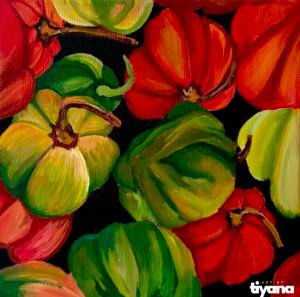
Scotch Bonnet — Acrylic on Canvas, 15 × 15 cm — Tiyana Duberry
Duberry believes women and artists get the visibility they deserve when they work consistently. In her view, audiences reward people who show up, and visibility grows through building communities and engaging with those who engage with their work. From what she has seen, women are getting their flowers.
Looking ahead, she hopes to connect with like-minded artists and join a network that shares her values. She wants a space where artists can put into words what they paint about.
View this post on Instagram
Duberry’s message to Caribbean women with a creative passion is to share their gift in a way that makes them proud. She encourages them to avoid posting for posting’s sake and to present their work where it can speak for itself.
If they handle their work with care, others will too, she says.
She urges creatives to block out the noise in their heads, which she calls the loudest place. Hitting the post button, she says, is three-quarters of the battle.
It might not always be on their timing, but the people will come, she adds.
To learn more about the artist and her work visit her website here.