
There are languages that survive because they are written into law, taught in classrooms, and protected by institutions. And then there are languages that survive because people refuse to let them die. For sisters Kimhia and Indira Toussaint, St. Lucian Kwéyòl belongs firmly in that second category, and their brand, Two Saints, is proof that sometimes the most radical act of preservation is simply showing up and speaking.
- Finding the Language in the Trenches
- [Additional Read:Chanté Timothy Wins Two 2026 Children’s Book Awards as “Supa Nova” Claims Double Victory]
- A Language That Was Never Broken
- “It is a full language. It has syntax, vocabulary, all of the structures a language requires. We are constantly reteaching people that this is not broken French.” — Indira Toussaint
- Tasting History at the Table
- “There’s a difference between reading that saltfish arrived in the Caribbean in the 16th century and actually eating a saltfish fritter while someone is telling you that story. Your body processes that information differently. You’re tasting history.” — Indira Toussaint
- “For a long time, a lot of us felt like we had to choose. Two Saints has helped me be more at peace with living what sometimes feels like a double life. I am very St. Lucian. I am also Black British. And I can celebrate both.” — Kimhia Toussaint
Born and raised in Micoud, St. Lucia, before migrating to the UK, the Toussaint sisters carry what many in the Caribbean diaspora know intimately: the experience of belonging to two worlds at once. Deeply Caribbean in a household that never let the islands go, while building a life in a country that doesn’t always see you fully. Two Saints was born from that in-between space, and fittingly, almost by accident.
“We started in the pandemic, out of that stillness,” Kimhia recalls. “It started as fun, honestly. We didn’t set out to build a business.” But people found them anyway. St. Lucians, Martinicans, speakers from every French Creole-speaking island, all searching for the same thing: a tangible connection to the places they’re from and the language they carry in their bodies but sometimes can’t quite access. The name itself came just as organically. Their surname is Toussaint, and an old acquaintance of Indira’s had a habit of saying “Two Saints, Two Saints,” and it stuck.
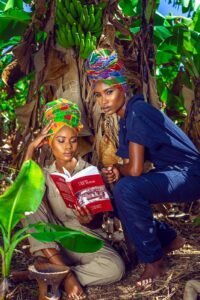
Photo courtesy of Jonathan Philip
Finding the Language in the Trenches
What drew the sisters deeper into the work was a gap they couldn’t ignore. Haitian Creole had a visible online presence, bolstered by its sheer number of speakers. But St. Lucian Kwéyòl was nearly invisible. “Finding how to write it, finding any kind of structured resource, was really challenging,” Indira explains. “So we went into the trenches. We collated writing systems, stories, and research. And then we asked ourselves: how do we package this so that it’s accessible, fun, and interactive?”
The answer became a full platform of courses, one-to-one tutoring, live webinar sessions, and immersive cultural experiences. But before any of that infrastructure existed, there was St. Lucia itself, functioning as its own kind of classroom. For Kimhia, every return visit deposits something new. “A few years ago, it was about generosity. Last year it was about living in the moment.” For Indira, the lessons are more weighted in history. She describes visiting Fond Doux, an area that served as a plantation for 250 years and a site of freedom fighting, with a group of students from Caribbean, British, and African backgrounds, none of them St. Lucian. “The gravity of that moment is something you cannot replicate from a textbook,” she says quietly. “That feeling is why we do what we do.”
[Additional Read:Chanté Timothy Wins Two 2026 Children’s Book Awards as “Supa Nova” Claims Double Victory]
A Language That Was Never Broken
“It is a full language. It has syntax, vocabulary, all of the structures a language requires. We are constantly reteaching people that this is not broken French.”
— Indira Toussaint
Few misconceptions cut deeper for the sisters than the long-standing dismissal of Kwéyòl as “broken French,” a label that has historically caused generations to hide or downplay their mother tongue. Indira pushes back with a pointed observation: “When I go to Paris, I can understand most of what people are saying, but they cannot understand me? That tells you something about the power in Creole, actually.”
Two Saints meet that challenge not with defensiveness but with what Kimhia calls “realness.” That means teaching language the way it’s actually spoken, including the fullness and texture of everyday life, and never shaming students about their accents. “Your accent tells your story,” Kimhia says. “We remind our students: you will never sound exactly like someone from St. Lucia if you’ve never lived there. But you can find your own voice in Kwéyòl. That’s what we’re here to help with.”
That philosophy extends to their workshops with older generations, which carry their own distinct reward. Elders sometimes arrive skeptical, uncertain what two young women could offer them about a language they’ve spoken all their lives. But for many, the writing system is entirely new. They hold the language in their bodies; they’ve just never seen it on a page. “By the end of those workshops,” Indira says, “the energy has completely shifted.”
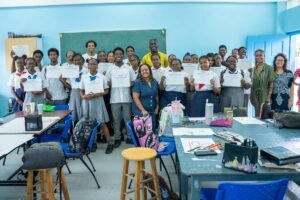
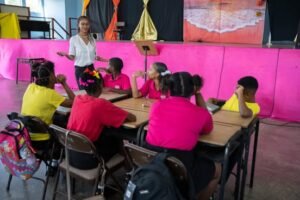
Photo courtesy of Nicolas Derné
Tasting History at the Table
“There’s a difference between reading that saltfish arrived in the Caribbean in the 16th century and actually eating a saltfish fritter while someone is telling you that story. Your body processes that information differently. You’re tasting history.”
— Indira Toussaint
If language is one vessel for culture, food is another, and Heritage Bites, Two Saints’ immersive dining experience, brings them both to the same table. The concept grew from Indira’s observation that food occupies an almost sacred communal role in Caribbean life, one she noticed most sharply through her partner, who didn’t grow up with that same centrality of eating together. “We asked: what is the best way to get people into a historical conversation without it being boring?”
At a Heritage Bites event held at a university, the answer revealed itself in a single, unrehearsed moment. The menu included roti. A transfer student took a bite and said, “This tastes like my mom’s cooking.” She wasn’t Caribbean. The connection crossed cultures entirely. A professor at the same event described it as a lesson in pedagogy, what it looks like to decolonize how we acquire information. Heritage Bites, Two Saints would say, is one answer to that question.
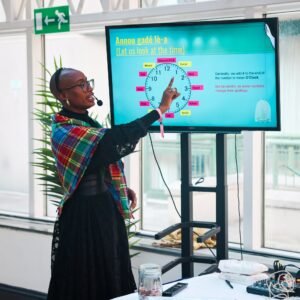
Photo courtesy of Remi Ldn
Permission to Be Both
“For a long time, a lot of us felt like we had to choose. Two Saints has helped me be more at peace with living what sometimes feels like a double life. I am very St. Lucian. I am also Black British. And I can celebrate both.”
— Kimhia Toussaint
At its core, Two Saints is doing something quieter and more personal than language instruction or dinner events. It is giving diaspora women, particularly those raising children between cultures or navigating hyphenated identities, something that no curriculum can assign: permission. Permission to exist in the duality. Permission to hold all of it without apology.
Kimhia puts it simply: “That’s what I want the brand to give other women too, that same freedom to hold it all without apology.” In a world that has long asked Caribbean people to flatten themselves for ease of consumption, Two Saints refuses. And in that refusal, a language lives.
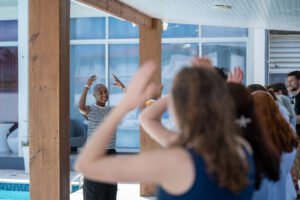
Photo courtesy of Bobby Regan
Two Saints offers St. Lucian Kwéyòl language courses, one-to-one tutoring, live webinar sessions, and immersive Heritage Bites cultural experiences. Find them at
twossaints.com and on Instagram @twossaints