
Cristiano Berti’s“Boggiano Heirs” uncovers the untold history behind the surname Boggiano in 19th-century Cuba. Boggiano, a common last name in the Afro-Cuban community today, comes with a history all too familiar. The book is an artist’s book written in the form of a historical essay and explores Italy’s pro-slavery era.
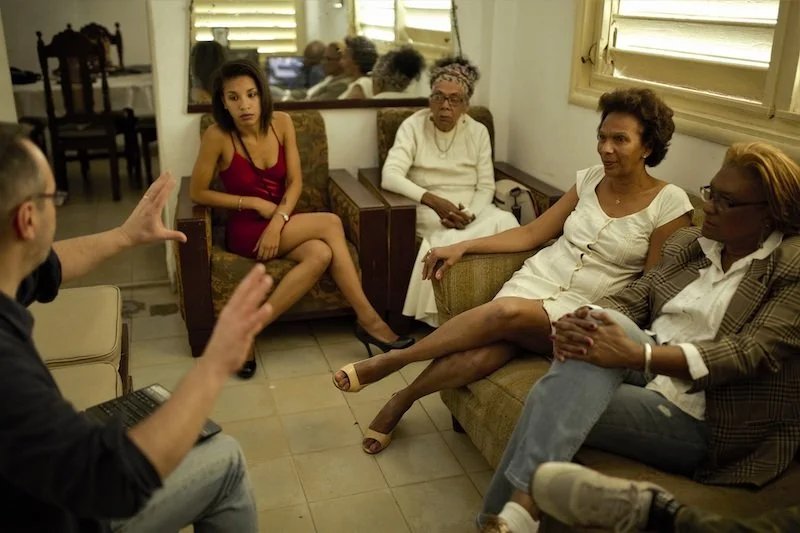
Berti speaking with Afro Cuban families, Photo courtesy of Piero Ottaviano
“Boggiano Heirs” tells the story of Antonio Boggiano, a wealthy Italian merchant who arrived in Cuba in 1796, at a time when much of Latin America remained under Spanish colonial rule. After working as a consignee for French slave ships and building capital through trade, Boggiano purchased a coffee plantation, later documented in 1809 under the name Nuestra Señora de la Misericordia, in an area called San José de los Puriales near the bustling city of Trinidad, a hub for the sugar and slave trades. At its height, the plantation held as many as 130 enslaved Afro-Cubans who cultivated the land.
… Boggiano’s decision to invest in coffee came from the fact that he could not afford to buy larger land suitable for sugar.
The enslaved population in 19th-century Cuba was subject to poor living conditions and inhumane treatment. Berti uses the term “ingenios” to describe sugar plantations particularly known for their harsh conditions. Plantations often held hundreds of enslaved people, forcing them into large barracks with poor sanitation that left them exposed to epidemics.
- … Boggiano’s decision to invest in coffee came from the fact that he could not afford to buy larger land suitable for sugar.
- [Additional Read: British Colonialism: Museum of London Docklands Curates an Exhibit Dedicated to Indo Caribbean Culture]
- Within these places, men outnumbered the women, and even when the women were present, those subjected to that rigor saw no reason to bring children into the world, condemning them to the same sufferance.
- Just like other Trinidadian hacendados (owners of rural estates), Boggiano complained about having to go all the way to the capital to identify his own cimarrones.
- 2026 Update
While coffee plantations such as Boggiano’s had somewhat better conditions, those in captivity still endured subpar living conditions. At one point, 16 Afro-Cubans who labored on Boggiano’s coffee plantation were killed by a cholera outbreak.
Within these places, men outnumbered the women, and even when the women were present, those subjected to that rigor saw no reason to bring children into the world, condemning them to the same sufferance.
To escape slavery, some sought freedom through suicide, believing they would return to their homeland as spirits. Those who attempted to flee were known as “cimarrones” and were often captured and returned to slavery after brutal punishment. The book delves into customary practices in Spanish America, where the only legal path to freedom was through its purchase.
Just like other Trinidadian hacendados (owners of rural estates), Boggiano complained about having to go all the way to the capital to identify his own cimarrones.
Though Boggiano built numerous businesses and properties, his own legacy is less compelling than the book’s exploration of how his surname spread through the Afro-Cuban community. That transmission has a specific origin: when the plantation was sold in 1857 to Diego Julián Sánchez, its laborers were required to take his surname instead. As a result, the Boggiano name survives today largely among descendants of those who had already purchased their freedom before the sale took place.
Art critic Seph Rodney describes Berti’s work as having “… a hushed history of entrepreneurship, travel, exploitation, enslavement, aspiration, intermixing of cultures and ethnicities, and laborious self-possession.” The book reflects a pattern seen across the West Indies: surnames taken from slave masters, like Boggiano, remain common in Caribbean households today, a reminder of a history that cannot be forgotten.
While the book acknowledges the history of exploitation, enslavement and cultural intermixing, Berti also frames the Boggianos’ story as one of fighting for freedom. He points to the discovery of “escribanos,” notary records preserving the deeds of Boggiano’s enslaved people who purchased their freedom, as the highlight of his research.
The book is the result of five years of historical research by Berti, developed with support from historical researcher Ada Almeira Bravo and photographer Piero Ottaviano. “Boggiano Heirs” is part of a larger project titled “Futile Cycles: Boggiano,”which also includes a 35-minute video and a wall installation featuring two large family trees built from 22 oval photographic portraits. The video weaves together stories collected in the area where Boggiano’s coffee plantation once stood and was screened at the National Museum of Fine Arts in Havana in March 2023.
The project’s historical and artistic relevance earned it the 10th Italian Council award in 2021, granted by the Italian Contemporary Creativity Directorate General of the Ministry of Culture, which promotes the production, knowledge and dissemination of contemporary Italian creation in the visual arts.
To purchase “Boggiano Heirs,” click here.
2026 Update
Since this article’s original publication, Berti has completed and exhibited one of the two Cuban Boggiano family trees, titled “Descendants of Rosa, Francisco and Liberata Boggiano.” The installation is a complex of frames containing photographs and paper materials, joined by connecting elements in enameled resin, and measures 3.5 meters high and more than 17 meters wide.
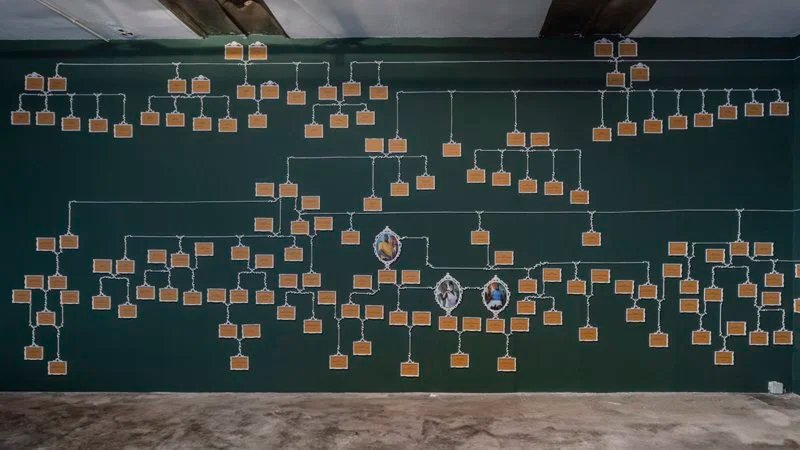
“Descendants of Rosa, Francisco and Liberata Boggiano” at Guido Cost Project, photo courtesy of Cristiano Berti
The work has since traveled internationally, including a showing at the 15th Havana Biennial in November 2024 and a screening at the Morra Greco Foundation in Naples in March 2024. In March 2025, Berti gave a talk titled “Monumento Viviente“at the Museo Casa de África in Havana.